
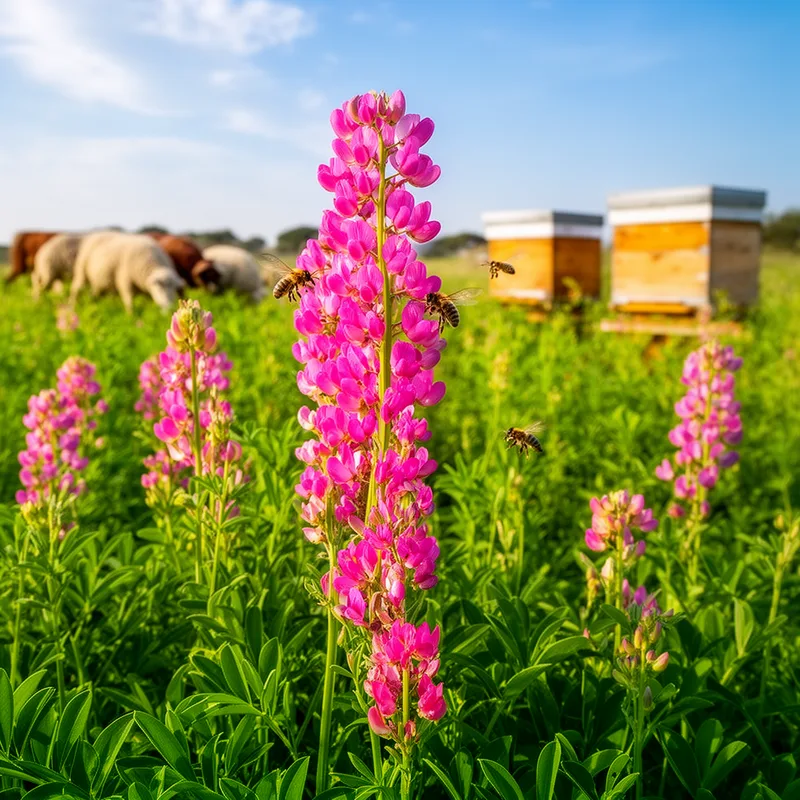
Hedysarum coronarium
- noun
- Specialized
- The bright pink flowers of Hedysarum coronarium attract bees, making it valuable to local beekeepers.
Examples
-
Farmers prefer Hedysarum coronarium because it improves soil fertility and provides nutritious forage for livestock.
-
Farmers often grow Hedysarum coronarium for livestock feed.
-
Hedysarum coronarium is often grown in Mediterranean regions for both grazing and honey production.
-
The Hedysarum coronarium plant thrives in well-drained soil.
-
Hedysarum coronarium is a popular choice among farmers for its sweet nectar, which is sought after by honeybees.
-
Many livestock owners cultivate Hedysarum coronarium to ensure their animals have access to nutritious forage.
-
In gardens, Hedysarum coronarium adds vibrant pink flowers that attract various pollinators.
Synonyms
A plant with pink flowers that lives for many years and is grown to feed animals and make honey

A plant with sweet smelling flowers that people grow for bees and to improve soil
Surface Forms
Morphology
Hedysarum + coronarium
This is a scientific Latin binomial (a proper taxonomic name), not a compositional English phrase; knowing the genus name 'Hedysarum' and an obscure Latin species epithet does not let a B1 learner infer the specific meaning (a perennial forage plant with nectar-rich flowers). The species epithet 'coronarium' is not a common English word and the agricultural/forage sense is encyclopedic rather than derivable from the parts, so the expression is effectively idiomatic/opaque for learners.
Etymology
The plant name Hedysarum coronarium may come from old Greek and Latin words: Hedysarum from a word meaning 'sweet' for its nectar, and coronarium from a word meaning 'crown' because the round pink flower clusters look a little like a small crown. So the name reminds us that this plant has sweet flowers that attract bees and are good for making honey.

