
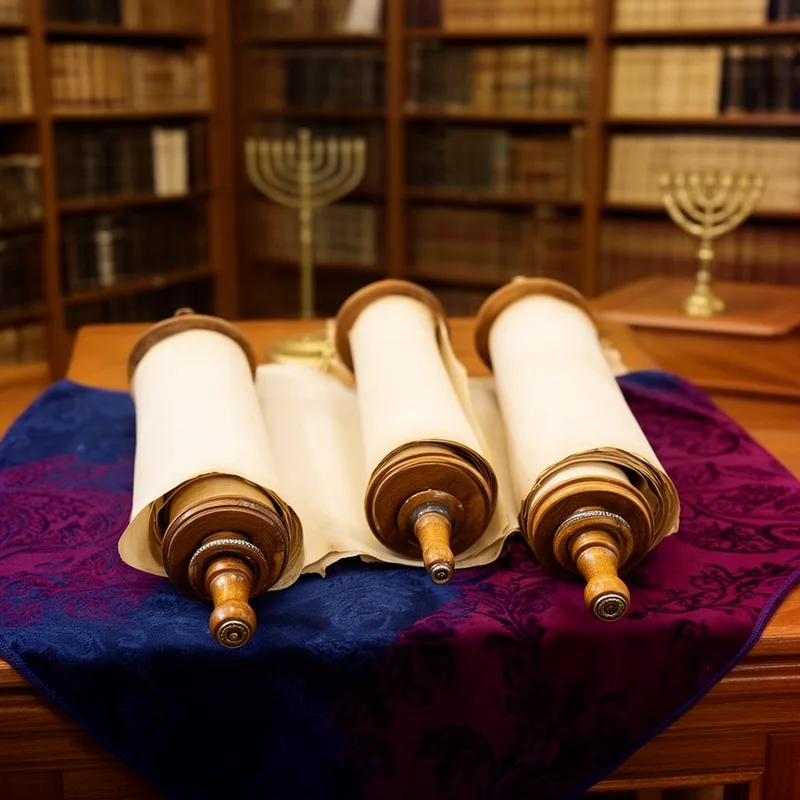
Hebrew Bible
 4
3.8
4
3.8

- noun
- /ˈhiːbruː ˈbaɪbəl/
- God does not speak again in the Hebrew Bible after He speaks to Job.
- the God of the Hebrew Bible
- looking at the Hebrew Bible
Loading YouTube…
Watch on YouTubeI think a lot of Gentiles in the ancient world found the Hebrew Bible a very strange text.
- I think a lot of Gentiles in the ancient world found the Hebrew Bible a very strange text.
- And even in the Hebrew Bible, there's a a moment where we get the first king of Israel, Saul.
- In the Old Testament, in the Hebrew Bible, God speaks with people.
- He reads the Hebrew Bible and says that is not a deity.
- Between Malachi in your Bible, cause in the Hebrew Bible, the the last book is not Malachi, but between Malachi and Matthew.
Examples
-
The Hebrew Bible speaks of "wiping away," "covering," "removing," and "sending away" sins.
Academic text (2003) -
The question of why the Nazirite has chosen his temporary way of life is never broached in the Hebrew Bible.
Academic text (2018) -
In the Old Testament, in the Hebrew Bible, God speaks with people.
-
It's a retelling of the Hebrew Bible story about God, the God of Israel.
-
I found the idea of studying the Hebrew Bible with the descendants of the people who wrote it quite appealing.
Academic text (2014) -
The Hebrew Bible presents us with "a religious community built upon the patriarchal family."
Academic text (2002) -
There are also works based on or related to the Hebrew Bible, sometimes called the Apocrypha and Pseudepigrapha.
Academic text (1994) -
On the one hand, the African American scholar/preacher realizes that Jesus does not figure in the Hebrew Bible.
Academic text (1994) -
For both groups, the Hebrew Bible was the major source of theological words and concepts ("covenant," "thanksgiving/confession," etc.).
Academic text (1994) -
Many scholars refer to the stories of creation in the Hebrew Bible as foundational texts of Judaism.
Synonyms
 16
4.0
16
4.0
Books that form the first part of the Christian Bible and contain Hebrew sacred writings
 1
9.9
1
9.9
A group of Jewish holy books, including the Torah, the Prophets and the Writings


 1
7.0
1
7.0
A set of Jewish sacred writings in three parts: the Torah, the Prophets, and the Writings

A collection of Jewish holy books, including the Torah, the Prophets, and the Writings
Surface Forms
Morphology
The meaning is directly compositional: 'Hebrew' specifies the cultural/language association and 'Bible' denotes sacred scriptures, so a learner can infer it refers to the Bible belonging to the Hebrews (i.e., the Jewish scriptures). This noun-modifier pattern is common across languages and follows standard English composition, making the sense immediately derivable for a B1 learner who knows both words.
Etymology
Hebrew Bible is named for the simple image of a book written mostly in Hebrew, and Bible means a book of 'sacred writings'. That's why Hebrew Bible is the neutral name used for the Jewish scriptures, the Torah, the Prophets, and the Writings.