

Hebrew
 54
5.2
54
5.2

- adjective
- /ˈhiːbruː/
- My friend taught me some common phrases in Hebrew during our trip to Israel.
- Hebrew language
- Hebrew Bible
- Hebrew literature
Loading YouTube…
Watch on YouTubeIt was the first time with with the the Hebrew mathematicians.
- It was the first time with with the the Hebrew mathematicians.
- At the climax of his story, the men's choir enters, singing Schoenberg's own setting of the Hebrew words of the Shmal Israel prayer, the central prayer of Judaism.
- I think a lot of Gentiles in the ancient world found the Hebrew Bible a very strange text.
- But cipher actually plays with the parallel Hebrew word, which is one of the source words in Kabbalah, which is Sipur story story.
- Why do you think in Aramaic, in Latin and in, in, in the Hebrew language, the word breath is the same as spirit.
- And I think the more Eastern in Hebrew mentality is very much like we are going to.
Examples
-
For centuries, the American imagination has been steeped in the Hebrew Scriptures.
Academic text (2008) -
All right, Hebrew school, let's put you to work.
-
I always forget he was in our Hebrew School class.
-
And I take art, advanced math, Hebrew history, art science.
-
I sang Hebrew songs at family gatherings.
-
Let me begin by examining the original Hebrew word for faith, emunah.
Academic text (1992) -
I have come to realize that the Hebrew Scriptures repeatedly show us and tell us who we are.
Academic text (1993) -
That's my Hebrew name.
-
Jesus, according to this bit of samizdat shtetl lore, attended Hebrew school like all the other kids.
Fiction book (2000) -
West of California, it was now dominated by kosher butchers, Jewish bookstores, and Hebrew day schools.
Fiction book (1998)
Synonyms


 1
8.7
1
8.7
Relating to the Hebrew people, their language, or their culture

Relating to the Hebrew people, their language, or their customs

Relating to the Israelites, especially in the Bible
Compounds


 1
4.6
1
4.6
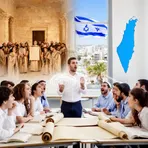
A language first used by ancient Jewish people, now the main language of Israel
 1
5.5
1
5.5
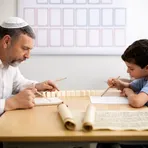
The standard form of Hebrew used in Israel today, brought back from ancient Hebrew
 1
7.0
1
7.0
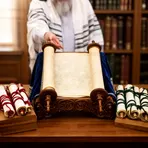
A set of Jewish sacred writings in three parts: the Torah, the Prophets, and the Writings

The form of Hebrew spoken and written in Israel today, brought back from ancient Hebrew

A calendar used by Jewish people that uses lunar months and adds leap months to match the seasons

An alphabet of letters used to write Hebrew and other Jewish languages, for example Yiddish and Ladino
Surface Forms
Etymology
Hebrew as an adjective comes from the same old name Ivri, meaning 'from the other side', so it simply means 'of the Hebrews' — about their language, culture, or history.