
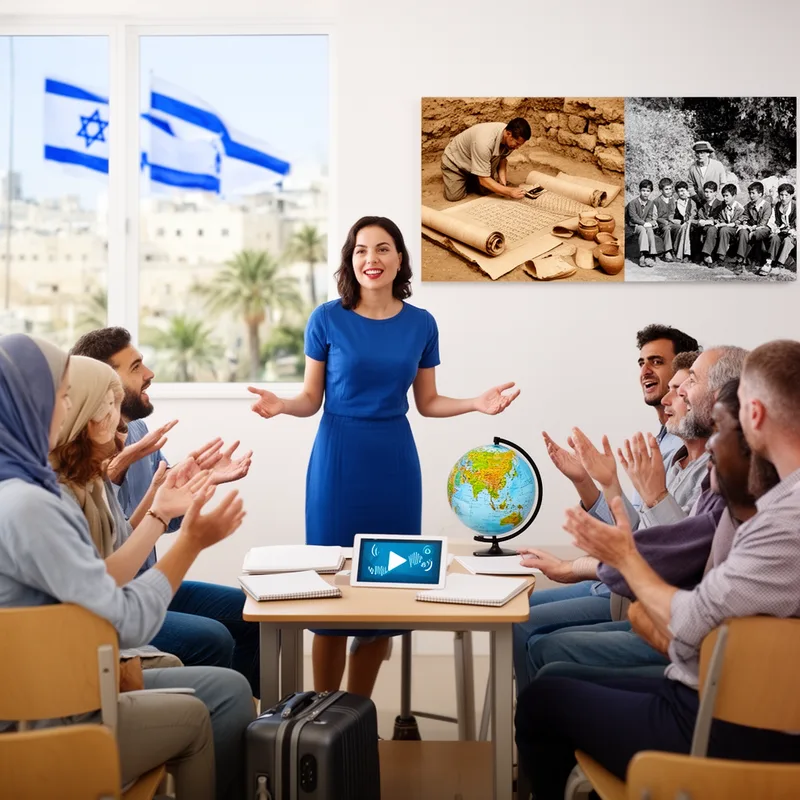
Modern Hebrew


 1
5.5
1
5.5
- noun
- /ˈmɒdərn ˈhiːbruː/
- The alternative to inclusive universalism proposed by Jewish advocates of Jewish history and modern Hebrew language and literature, namely a consensual yet pluralist vision for the university, similarly failed to overcome prejudice in the academy.
Examples
-
"Nevertheless, in a short time he became one of the finest essayists in modern Hebrew.
Academic text (2009) -
Some of the neologisms in modern Hebrew have a kind of bizarre history.
-
Thus, hashmal in modern Hebrew means "electricity."
Academic text (2009) -
Eventually, I went to Israel, learned modern Hebrew, came back, and attended a text-critical college of Jewish studies.
Blog text (7) -
Modern Hebrew also has subject-first word order.
Blog text (7) -
Note: Verbs in modern Hebrew, as used in Israel today, do act much like English verbs.
Blog text (7) -
Appelfeld, a Holocaust survivor who teaches literature at Ben-Gurion University of the Negev, is a leading modern Hebrew novelist.
Fiction book (1996) -
Many students are enrolling in courses to learn Modern Hebrew as it is increasingly important for understanding contemporary Israeli culture.
-
The word 'kibbutz' is a term borrowed and widely used in Modern Hebrew to describe collective communities in Israel.
-
In linguistic studies, Modern Hebrew is often analyzed for its unique blend of ancient roots and modern usage.
Synonyms
 1
4.6
1
4.6
A language first used by ancient Jewish people, now the main language of Israel

An ancient language now used as the modern language of Israel
Surface Forms
Morphology
The phrase 'Modern Hebrew' is compositionally transparent: 'modern' simply qualifies 'Hebrew' to indicate the contemporary form of the language, so a learner who knows both words can infer it refers to the current/revived standard. This adjective+noun pattern is cross-linguistically common and follows straightforward English compounding, making the meaning accessible to a B1 learner.
Etymology
Modern Hebrew comes from a time when ancient Hebrew was mostly used in books and prayers, and then people in the 1800s and 1900s brought it back as a language for everyday life. That's why Modern Hebrew now means 'the Hebrew spoken and written in Israel today'.