
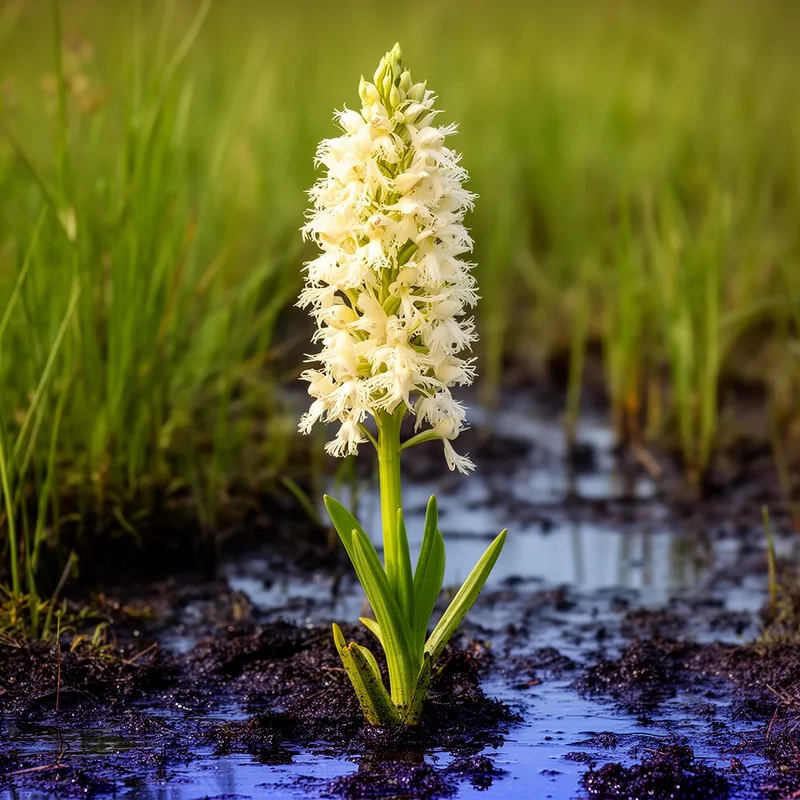
Habenaria leucophaea
- noun
- Specialized
- The Habenaria leucophaea thrives in marshy areas and produces a sweet fragrance in early summer.
Examples
-
Botanists are working to protect the Habenaria leucophaea as its wetland habitat decreases.
-
We spotted a blooming Habenaria leucophaea during our hike through the national wildlife refuge.
-
The Habenaria leucophaea is known for its beautiful flowers.
-
You can find Habenaria leucophaea in wetland areas.
-
The Habenaria leucophaea grows abundantly in the wetlands of the Midwest, showcasing its creamy white flowers during blooming season.
-
In the early summer, the Habenaria leucophaea fills the air with its sweet fragrance, attracting various pollinators.
-
Conservation efforts are in place to preserve the Habenaria leucophaea, which is at risk due to the loss of its natural boggy habitats.
Synonyms

A fragrant orchid that grows in wet prairie meadows with white fringed flowers

A wild flowering plant in North American wet prairies with small creamy scented flowers
Surface Forms
Morphology
Habenaria + leucophaea
This is a Latin binomial: knowing 'Habenaria' as a genus of terrestrial orchids lets a B1 learner infer that the phrase names a species of orchid (so the broad category is predictable). However, 'leucophaea' is not an English word and its meaning (pale/cream-coloured flowers, habitat details) is not accessible to an average B1 learner, so the specific senses are not derivable from the constituents.
Etymology
Habenaria leucophaea comes from old Greek and Latin words. Habenaria means 'strap', referring to the flower's long thin lip, and leucophaea means 'pale white', so the name fits this creamy, fragrant orchid.

