

prairie orchid
- noun
- /ˈprɛəri ˈɔrkɪd/
- US
- Botanists conducted surveys to monitor the blooming periods of the prairie orchid each spring.
Examples
-
The rare prairie orchid is protected in several wildlife reserves across the Midwest.
-
Conservation groups are working to restore wetland habitats suitable for the prairie orchid to thrive.
-
The prairie orchid blooms in the spring.
-
Many prairie orchids thrive in wetland areas.
-
Conservation groups are working to restore wetland habitats suitable for the prairie orchid to thrive.
-
The rare prairie orchid is protected in several wildlife reserves across the Midwest.
-
Many prairie orchids thrive in wetland areas.
Synonyms

A fragrant orchid that grows in wet prairie meadows with white fringed flowers

An orchid that grows in wet places like marshes and has very fragrant creamy white flowers
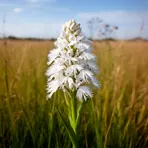
A rare wildflower with white, fringed petals that grows in prairies
How Fragrant
- US

 165
1.0
165
1.0

Surface Forms
Morphology
The compound simply names a type of orchid associated with a prairie habitat, so the meaning 'an orchid that grows in prairies' is directly and transparently derivable from 'prairie' + 'orchid'. This is a straightforward noun–noun composition denoting type/location and follows common cross-linguistic naming patterns, making it accessible to a B1 learner who knows both constituents.
Etymology
Prairie orchid is a compound name that joins prairie, meaning 'open grassland', and orchid, a kind of 'flower'. Botanists gave this name to the native orchid that grows in wet prairies, so the name tells you 'where it lives'.