
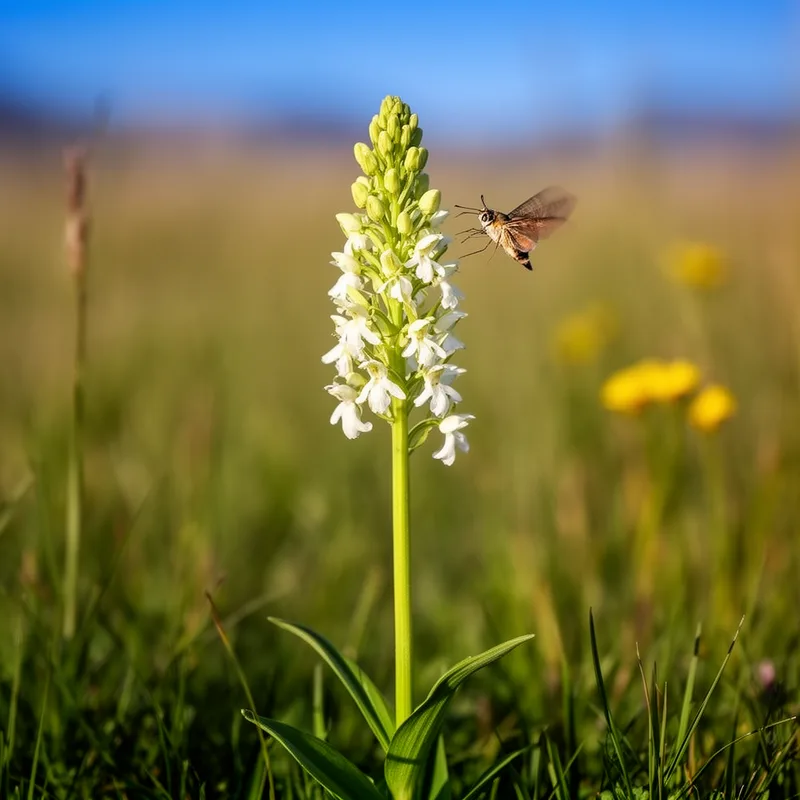
Habenaria bifolia
- noun
- Specialized
- The rare Habenaria bifolia blooms in the meadows of southern Europe each spring.
Examples
-
The Habenaria bifolia blooms in the spring.
-
Have you seen a Habenaria bifolia in the wild?
-
Botanists studied the fragrance profile of Habenaria bifolia for potential horticultural uses.
-
Some scientists debate whether Habenaria bifolia belongs in the genus Habenaria or a separate one.
-
The rare Habenaria bifolia blooms in the meadows of southern Europe each spring.
-
Some scientists debate whether Habenaria bifolia belongs in the genus Habenaria or a separate one.
-
Botanists studied the fragrance profile of Habenaria bifolia for potential horticultural uses.
Synonyms
A small southern European orchid with pale green and white flowers that smell sweet
A small European orchid with fragrant pale greenish-white flowers
Surface Forms
Morphology
Habenaria + bifolia
The binomial is compositionally predictable: it combines the genus name Habenaria (a type of terrestrial orchid) with a specific epithet that likely describes a feature (bifolia = ‘two‑leaved’). However, the epithet is Latin and absent from the provided dictionary entry, and taxonomic Latin is specialized, so a typical B1 learner would only derive the precise meaning if they already knew the Latin/technical epithet, making it only partially transparent.
Etymology
Habenaria bifolia may come from Latin words: Habenaria from a word for a 'strap' and bifolia meaning 'two leaves'. The flowers have long strap-like parts and the plant usually has two main leaves, so the name gives a simple picture to help you remember this orchid.

