

Platanthera bifolia
- noun
- Specialized
- Many botanists travel to observe Platanthera bifolia in its natural habitat during its blooming season.
Examples
-
The Platanthera bifolia blooms in early summer.
-
The rare Platanthera bifolia was spotted in the alpine meadow during our nature walk.
-
Gardeners are advised that Platanthera bifolia thrives best in moist, lightly shaded soil.
-
Look at that Platanthera bifolia!
-
Many botanists travel to observe Platanthera bifolia in its natural habitat during its blooming season.
-
Gardeners are advised that Platanthera bifolia thrives best in moist, lightly shaded soil.
-
The rare Platanthera bifolia was spotted in the alpine meadow during our nature walk.
Synonyms
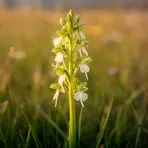
A small southern European orchid with pale green and white flowers that smell sweet

A small orchid from southern Europe with pale green and white flowers that smell sweet
Surface Forms
Morphology
Platanthera + bifolia
The item is a Latin binomial: 'Platanthera' names an orchid genus (so a learner aware of that could infer it refers to an orchid species), but 'bifolia' is a Latin species epithet (literally ‘two‑leaved’) and is not a common English word in the input. Therefore the connection to the precise common name ('lesser butterfly‑orchid') is only partially derivable—there is some compositional information but the taxonomic/Latin nature makes the meaning not fully predictable to a B1 learner without prior exposure.
Etymology
Platanthera bifolia comes from old Greek and Latin words: platanthera meaning 'wide pollen part' and bifolia meaning 'two leaves'. That name fits the plant because it usually has a broad pollen-bearing part and two leaves, so the words describe how it looks.

