
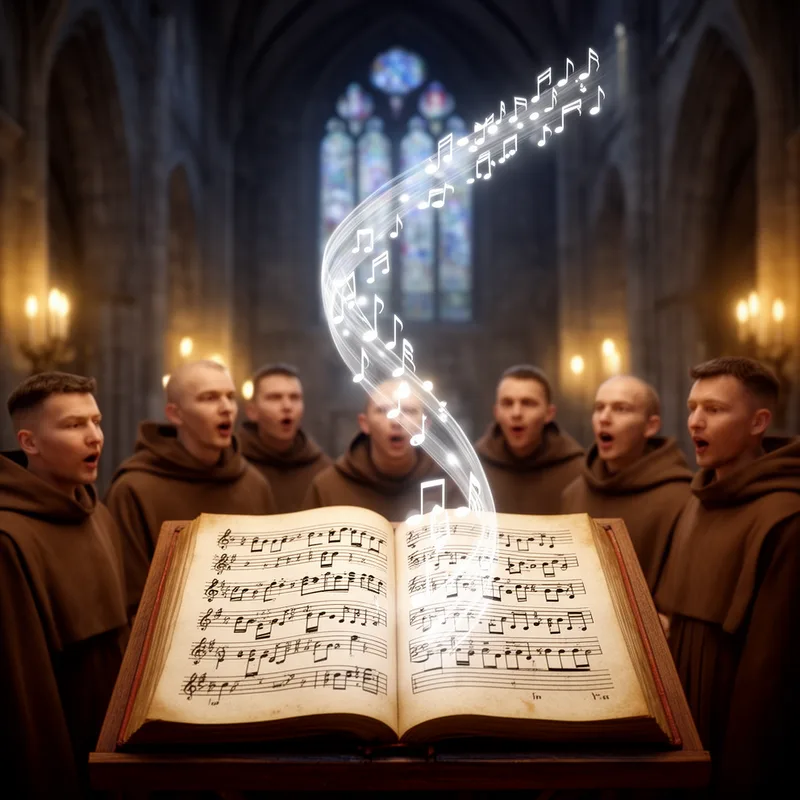
Gregorian mode
- noun
- /ɡrɪˈɡɔːriən moʊd/
- Specialized
- Many compositions were written in the Dorian mode, one of the eight Gregorian modes.
Examples
-
Musicians studying early music often explore the unique characteristics of the Phrygian mode in Gregorian chant.
-
The Gregorian mode used in this chant evokes a sense of peace and spirituality.
-
Accidentals are limited to F, G, C-sharp, B, and E-flat, found in plainsongs and related to Gregorian modes.
Academic text (2018)
Synonyms
 10
7.0
10
7.0

A set of notes used to make a musical scale, like major or minor

A pattern of notes used in old Western music like Gregorian chant

A pattern of notes that church singers use in medieval chant

A pattern of musical notes used in old church music that gives a melody its own sound

A pattern of eight notes that gives a piece of Western music its typical sound
Surface Forms
Morphology
The term is fully compositional: 'Gregorian' specifies relation to Gregorian chant and 'mode' denotes a musical scale or diatonic sequence, so together they mean a musical mode used in Gregorian chant. Although the concept is somewhat technical, a B1 learner who knows both constituents (and basic musical sense of 'mode') can derive the meaning; the modifier+noun logic is cross-linguistically common.
Etymology
Gregorian mode may come from Pope Gregory I, who was said to collect and organise early church songs, and mode simply means a musical 'scale' or pattern. So a Gregorian mode is one of the special scales used in Gregorian chant that gives each chant its own mood.