

Great Pyramid
 5
4.4
5
4.4

- noun
- /ɡreɪt ˈpɪrəmɪd/
- Around 2600 B.C.E., inclined planes were used, at least in part, to raise the blocks of stone that make up the Great Pyramid.
- the construction of the Great Pyramid
- survey the Great Pyramid
Loading YouTube…
Watch on YouTubeAnd it just so happens while he was in the Great Pyramid, you know, he sent his workers home.
- And it just so happens while he was in the Great Pyramid, you know, he sent his workers home.
- So NASA owns the rights to the interior of the Great Pyramid?
- But you all, you also made a pretty in depth video on the Great Pyramid of Giza.
- But what would last is massive megalithic structures like the Great Pyramid that would that would last.
- So I, I, I've been three or four nights in a row inside the Great Pyramid receiving people.
- The key is the wisdom of understanding relative to the Great Pyramid, the mystery of it.
- So not only that, but now type in Great Pyramid, ratio of Earth, Great Pyramid of Giza, Yeah.
- I mean, I've seen people really affected tremendously just by, you know, going into Great Pyramid.
Examples
-
Of the seven wonders, only the Great Pyramid still exists.
Blog text (23) -
The enormous size and weight of the stones, multiplied by the sheer number of them, makes one thing certain: the construction of the Great Pyramid remains one of the greatest marvels and mysteries of architectural engineering.
-
Nobody really knows for sure who built the Great Pyramid or how it was constructed.
Blog text (10) -
There are plenty of theories about how the Great Pyramid could have been built that lack evidence.
Academic text (2007) -
There's a hidden chamber in the Great Pyramid.
-
Of the seven wonders of the ancient world, only the Great Pyramid of Giza remains.
Academic text (2007) -
The crane theory can't explain how the blocks of the Great Pyramid were raised.
Academic text (2007) -
We know who built the Great Pyramid: the pharaoh Khufu, who ruled Egypt about 2547-2524 B.C.
Academic text (2007) -
Of the seven wonders of the ancient world, only the Great Pyramid of Giza remains.
-
Perhaps the best-known and mysterious stone structure in the world is the Great Pyramid of Giza.
Synonyms
 1
4.0
1
4.0
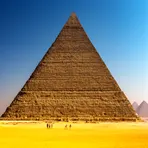
A very large ancient Egyptian tomb in Giza built for the king Khufu about 2600 BC
Surface Forms
Morphology
The meaning is directly and transparently built from 'great' (large/important) + 'pyramid' (a stone tomb with triangular sides); the adjective–noun composition straightforwardly indicates a notably large or famous pyramid. This is a common, cross-linguistic descriptive pattern, so a B1 learner who knows both constituents would readily infer the intended meaning (typically the famous Giza pyramid).
Etymology
Great Pyramid gets its name from being the very large pyramid built as a royal 'tomb' for the pharaoh Khufu at Giza. That's why the name now means the single big, famous Egyptian pyramid of Khufu.