
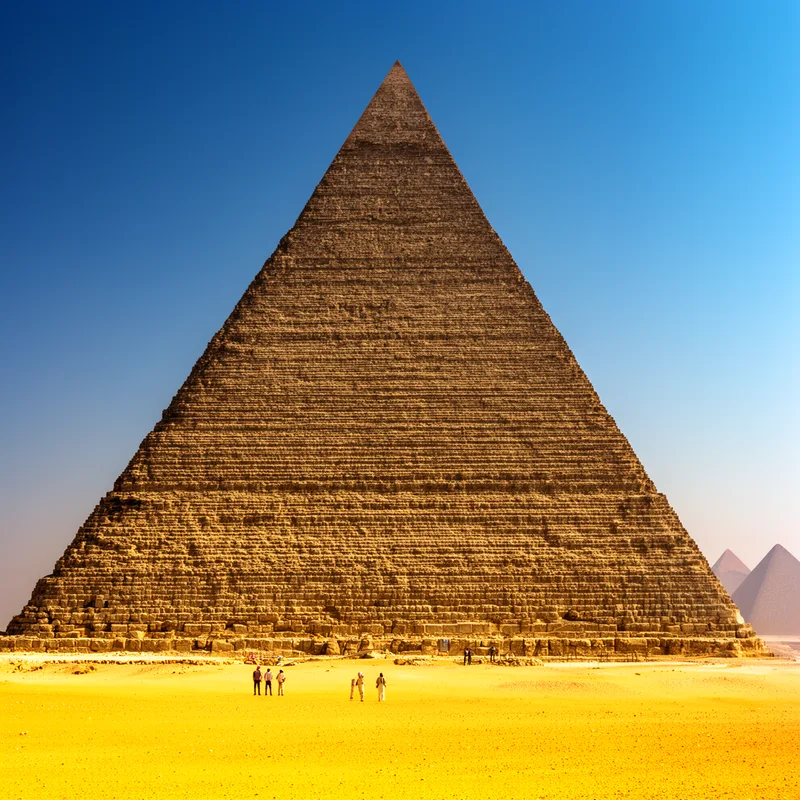
Great Pyramid of Giza
 1
4.0
1
4.0

- proper noun
- Of the seven wonders of the ancient world, only the Great Pyramid of Giza remains.
Examples
-
Historians study the Great Pyramid of Giza to learn more about ancient Egyptian architecture and burial practices.
-
He knew ancient Egypt as if he had lived in it: your grandmother and I spent more than one dinner listening to your cousin narrate such events as the building of the Great Pyramid of Giza, the factual accuracy of which I couldn't verify but whose telling kept me enthralled.
Fiction book (2002) -
The Great Pyramid of Giza is a remarkable tomb built for Pharaoh Khufu over 4,500 years ago.
-
Many tourists visit the Great Pyramid of Giza to marvel at its colossal structure and historical significance.
Synonyms
 5
4.4
5
4.4
A very large ancient Egyptian tomb for Pharaoh Khufu at Giza with a square base and four triangle-shaped sides
Surface Forms
Morphology
The meaning is directly compositional: 'great' + 'pyramid' + 'of' + 'Giza' straightforwardly yields 'the large pyramid located in Giza.' This simple proper‑name noun phrase follows common cross‑linguistic patterns and a B1 learner who knows the constituent words would readily infer the referent and basic significance.
Etymology
Great Pyramid of Giza is a huge stone pyramid on the plain of Giza, built as a 'tomb' for Pharaoh Khufu about 2600 BC so you can picture a giant man-made mountain holding a king and his treasures. That's why the word Great shows it is the largest pyramid there, and why people still call it a 'wonder' of the ancient world.