

Golgi complex
- noun
- /ˈɡoʊldʒi ˈkɒmplɛks/
- Specialized
- Inside eukaryotic cells, the Golgi complex is essential for lipid transport.
Examples
-
The Golgi complex plays a crucial role in protein processing.
-
Secretory cells contain a well-developed Golgi complex to handle the volume of materials they export.
-
Scientists observed changes in the Golgi complex during the cell's lifecycle.
-
The Golgi complex plays a crucial role in packaging proteins for transport.
-
The Golgi complex plays a crucial role in packaging proteins that are sent out of the cell.
-
Proteins produced in the endoplasmic reticulum are modified and sorted by the Golgi complex before secretion.
-
Defects in the Golgi complex can lead to improperly folded proteins and various cellular problems.
Synonyms

A part inside a cell that changes, sorts, and packs proteins and fats to send them out
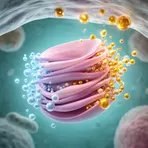
A part inside a cell that changes and packs proteins to send them out
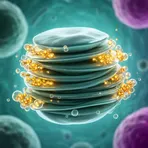
A group of flattened sacs in a cell that change and package proteins
Surface Forms
Morphology
Golgi + complex
This is an eponymic technical term: 'Golgi' is a proper name (not semantically informative to a B1 learner) and 'complex' only signals a multi-part structure. Knowing the constituents does not allow a learner to infer that this is a cellular organelle involved in protein/lipid processing, so the meaning is not derivable from the parts.
Etymology
Golgi complex is named after the Italian scientist Camillo Golgi, who first saw this structure in cells with a microscope. It looks like a stack of flat sacs, so people imagine it as the cell's 'post office' that 'packages' and 'sends' proteins to other parts of the cell, which explains its modern meaning.

