

Golgi apparatus
- noun
- /ˈɡoʊldʒi əˈpærətəs/
- Specialized
- In the Golgi apparatus, proteins are processed and then packaged into new vesicles.
Examples
-
The vesicles transport the newly made proteins from the rough ER to the Golgi apparatus.
-
The Golgi apparatus plays a crucial role in cellular processes.
-
Disruption of the Golgi apparatus can affect the secretion of enzymes in certain cells.
-
Proteins are packaged and modified in the Golgi apparatus before being sent to their destination.
-
The scientist observed a well-developed Golgi apparatus in the glandular cells under the microscope.
-
In eukaryotic cells, the Golgi apparatus modifies proteins.
-
The transfer of soluble proteins from the ER to the Golgi apparatus, for example, occurs in this way.
Synonyms

Small sacs inside a cell that change, sort, and pack proteins and fats for transport
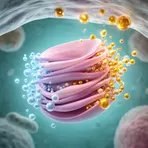
A part inside a cell that changes and packs proteins to send them out
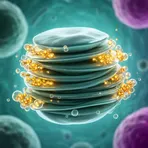
A group of flattened sacs in a cell that change and package proteins
Surface Forms
Morphology
Golgi + apparatus
The term combines a proper name 'Golgi' (no inherent lexical meaning) with 'apparatus' (which signals an organized system or device), so a learner might infer it refers to some system or biological structure but cannot derive the specific organelle or its functions. The precise cellular role is technical and language-specific, requiring subject knowledge rather than simple composition, so it is partly but not fully predictable to a B1 learner.
Etymology
Golgi apparatus is named after the scientist Golgi, who saw a stack of thin layers that looked like a small machine under his microscope. Because apparatus means a little machine, that image of a machine that 'sorts' and 'packages' things helps you remember that the Golgi 'sorts' and 'packs' proteins and lipids to send them to the right place in the cell.

