
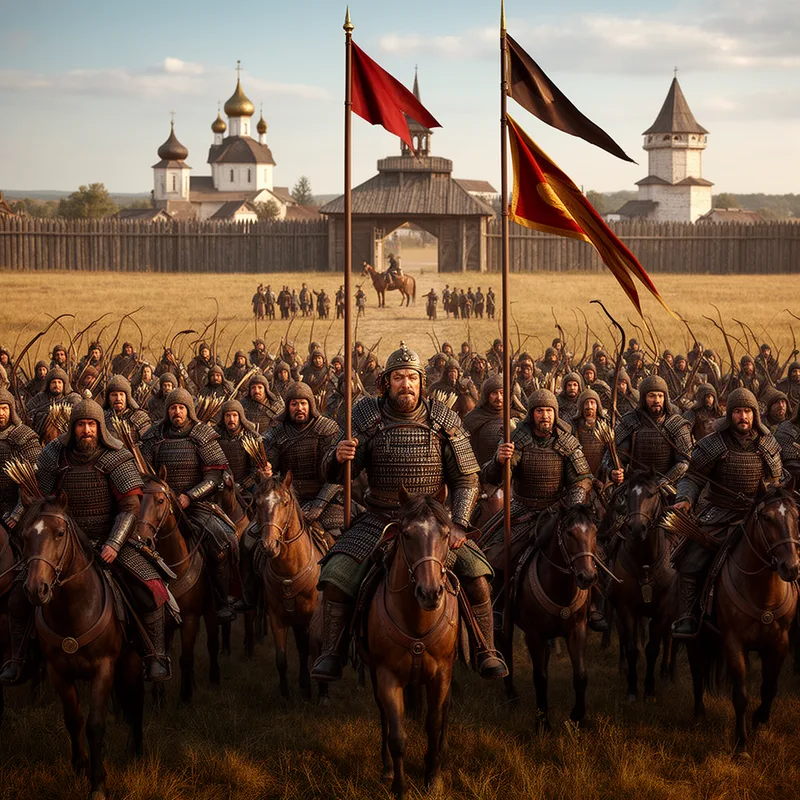
Golden Horde
- noun
- /ˈɡoʊldən hɔrd/
- After years of infighting, the Golden Horde now began to disintegrate into rival Kanates.
- Batu Khan of the Golden Horde
Loading YouTube…
Watch on YouTubeThe Grand Prince of Muscovy ends up uniting all the very young peoples and then is able to take the fight to the steppe nomads and drive out the Golden Horde.
- The Grand Prince of Muscovy ends up uniting all the very young peoples and then is able to take the fight to the steppe nomads and drive out the Golden Horde.
- And then the history of post Mongol statehood is the Golden Horde breaking up into smaller units.
Examples
-
Then the Golden Horde.
-
In India and in Eastern Europe, the Golden Horde ruled for years until a trading post named Muscovy grew into a major world power.
-
And then the history of post Mongol statehood is the Golden Horde breaking up into smaller units.
-
After years of infighting, the Golden Horde now began to disintegrate into rival khanates.
-
Chechens were Tartars, a western tide of the Golden Horde that had settled in the fastness of the Caucasus Mountains.
Fiction book (1992) -
During the 14th century, much of Russia was under the control of the Golden Horde, which imposed new laws on trade and governance.
-
The Golden Horde played a significant role in the history of Eastern Europe by influencing regional politics for nearly three centuries.
-
Chechens are considered part of the cultural legacy of the Golden Horde, which once ruled over vast territories in the Caucasus.
Surface Forms
Morphology
The constituents 'golden' (notably valuable/important) and 'horde' (a large group) give a learner a partial, literal sense—i.e., a notable large group—but they do not supply the specific historical referent (the Mongol army occupying parts of Eastern Europe/Russia in the 13th–14th centuries). As a proper historical name the full meaning (ethnic identity, historical role and timeframe) is unpredictable from the parts, so learners would only get a general idea, not the specific sense.
Etymology
Golden Horde may come from a simple picture: a huge Mongol camp or army—horde—with shiny, golden tents or banners—golden—that looked rich and strong. That's why the name now means the Mongol army that invaded and controlled parts of eastern Europe and Russia.

