

horde
 20
6.3
20
6.3

- noun
- /hɔrd/
- Archaic
- Tribes of the horde often moved together, sharing resources as they wandered.
Loading YouTube…
Watch on YouTubeThe way the Black Death spreads is that the the people on the side of the Golden Horde are dying of the Black Death.
- The way the Black Death spreads is that the the people on the side of the Golden Horde are dying of the Black Death.
- And then the history of post Mongol statehood is the Golden Horde breaking up into smaller units.
- The Grand Prince of Muscovy ends up uniting all the very young peoples and then is able to take the fight to the steppe nomads and drive out the Golden Horde.
Examples
-
In India and in Eastern Europe, the Golden Horde ruled for years until a trading post named Muscovy grew into a major world power.
-
In the next few years the Mongol hordes of Genghis Khan... seized all of China north of the Yellow River.
-
Which way did the Jun horde go?
-
With these we hope to stem the Egyptian horde?
-
And then the history of post Mongol statehood is the Golden Horde breaking up into smaller units.
-
The modern ownership of movables is reducing us to a nomadic horde.
-
After a gruelling struggle, the Turkic horde was crushed and routed.
-
Egypt was unequal to a horde of desert tribesmen... when they'd scarcely a pistol to call their own.
-
It all began in 484 AD, when King Arthur and his wizard, Merlin, stared down and vanquished the Saxon hordes at Mount Badon.
-
The nomadic horde traveled across the plains in search of better pastures.
Synonyms
 84
4.1
84
4.1
A group of people who travel together with animals or vehicles for safety across a desert
 15
5.6
15
5.6
A large group of ordinary people in a society
Antonyms
Compounds
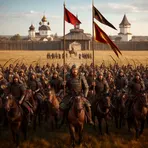
A Mongol army that invaded and ruled parts of eastern Europe and Russia in the 1200s and 1300s
How Large

Surface Forms
Etymology
Horde originally came from a Central Asian word ordu meaning 'camp' or 'army', and it was used for nomad tribes like the Mongols who moved as one community. That's why horde can mean a large tribe or group that travels together.