

German mark
 3
4.0
3
4.0

- noun
 :
marco alemán
:
marco alemán
- Before the euro was adopted, the German mark was widely used for transactions in Germany.
- East German mark
- West German mark
They would borrow these currencies with the promise of paying them back with interest, and then sell the borrowed currencies to buy German marks.
- They would borrow these currencies with the promise of paying them back with interest, and then sell the borrowed currencies to buy German marks.
Examples
-
Many Germans worry about the loss of the German mark (DM) and put little credence in the politicians' assertions that the Community currency will be at least as stable as the DM.
Academic text (1991) -
In both cases, the authorities could not print money fast enough to outpace their currency's falling value, and the systems collapsed—so Yugoslavs began using a new currency tied to the German mark, and Zimbabweans used a currency tied to the dollar.
Blog text (1) -
The German mark fell to 18,000 to the dollar.
Blog text (1) -
However, should you prefer German marks, or perhaps Swiss francs, that, of course, can be arranged.
-
The Ministry can generate a passport, and if you had the American dollars or German marks, then you could simply buy a seat on the plane and take off.
Fiction book (1992) -
West Germany promises 3.5 million West German marks (U.S. $2 billion) in new credit guarantees.
Academic text (1990) -
In Europe, smaller countries often peg their currencies to the German mark, allowing the Bundesbank to determine their monetary policies.
Academic text (1993) -
Agreement was reached that on 1 July 1990, the Federal Republic would exchange, within certain limits, valuable, convertible West German marks for the less valuable, nonconvertible East German marks.
Academic text (1991) -
The huge price paid by Chancellor Helmut Kohl to bring about quick unification—an exchange of West German marks for East German marks at an overpriced one-to-one rate and a transfer of capital to the East.
Academic text (1994) -
However, when the director ran into a major problem of insufficient funding to produce an opulent Renaissance-style film, the Prague Studios Barrandov (also called the "Hollywood of the East") sought cooperation with their East German colleagues in Babelsberg, who were ready to contribute 1 million East German marks.
Academic text (2017)
Synonyms
 51
8.6
51
8.6
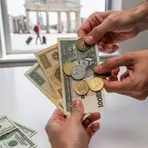
The old money used in Germany before the euro
 2
6.5
2
6.5
The money used in Germany before the euro
 1
6.5
1
6.5
Money used in Germany before it adopted the euro in 2002
Surface Forms
Morphology
The phrase is fully compositional: the adjective 'German' specifies the national origin and 'mark' denotes a currency unit, so together they straightforwardly mean the currency of Germany. This adjective+noun pattern is cross-linguistically common and a B1 learner who knows both words can readily infer the MWE's meaning.
Etymology
German mark comes from the old word mark, which meant a fixed weight of silver that traders used to pay and trade. So the word became the name for German 'money' used before the euro.