
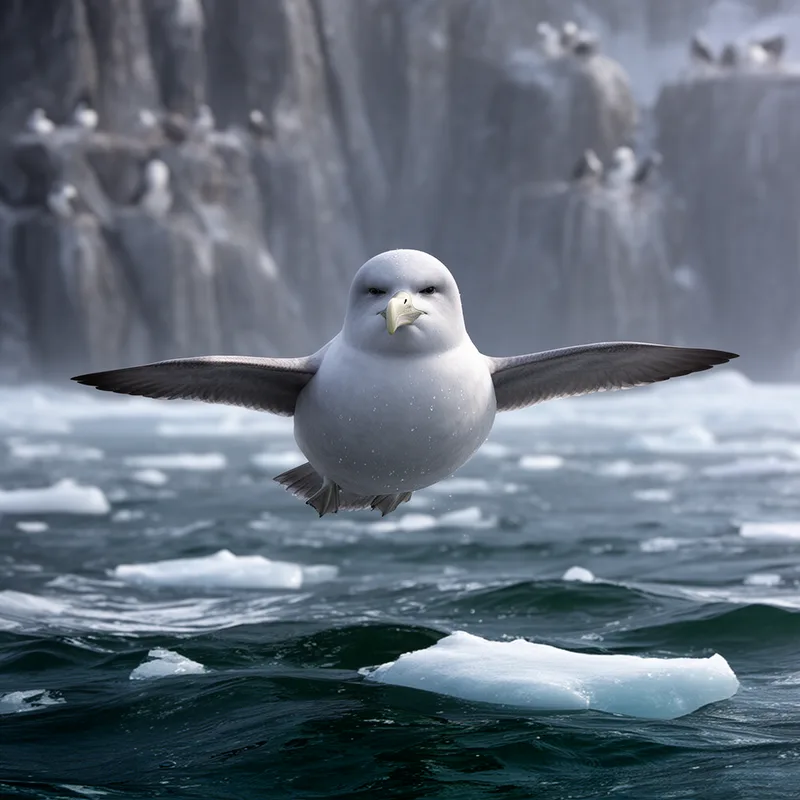
Fulmarus glacialis
- noun
- Specialized
- Researchers observed that the nesting sites of Fulmarus glacialis are often located on steep coastal cliffs.
Examples
-
The migration patterns of Fulmarus glacialis take it across both the North Atlantic and the Arctic oceans.
-
The Fulmarus glacialis is known for its distinctive tube-shaped nostrils.
-
A Fulmarus glacialis glided steadily just above the icy waves, searching for food.
-
Many bird watchers are excited to see the Fulmarus glacialis during their trips to the Arctic.
-
A Fulmarus glacialis soared gracefully over the icy waters while searching for fish.
-
During the summer months, Fulmarus glacialis can be seen nesting on the rugged cliffs of northern coasts.
-
Observers noted that the Fulmarus glacialis often returns to the same nesting site year after year.
Synonyms

A large sea bird with a short tail that lives in cold northern oceans

A large seabird with a short tail that glides over cold oceans
A seabird like a gull that lives in cold oceans
Surface Forms
Morphology
Fulmarus + glacialis
The binomial combines a known seabird genus (Fulmarus) with a descriptive epithet ('glacialis' = relating to glaciers or ice), so the overall meaning — a fulmar associated with glacial/polar regions — is directly inferable from the parts. Although 'glacialis' is Latin and not listed in the provided dictionary entry, its meaning is transparently descriptive, making the name compositional rather than idiomatic.
Etymology
Fulmarus glacialis may come from older words meaning Fulmarus 'foul gull' and glacialis 'icy'. The 'foul' part fits the bird's habit of spitting a smelly, oily liquid to 'defend' itself, and the 'icy' part fits the cold places where it lives, so the name points to the bird and the way it lives.

