
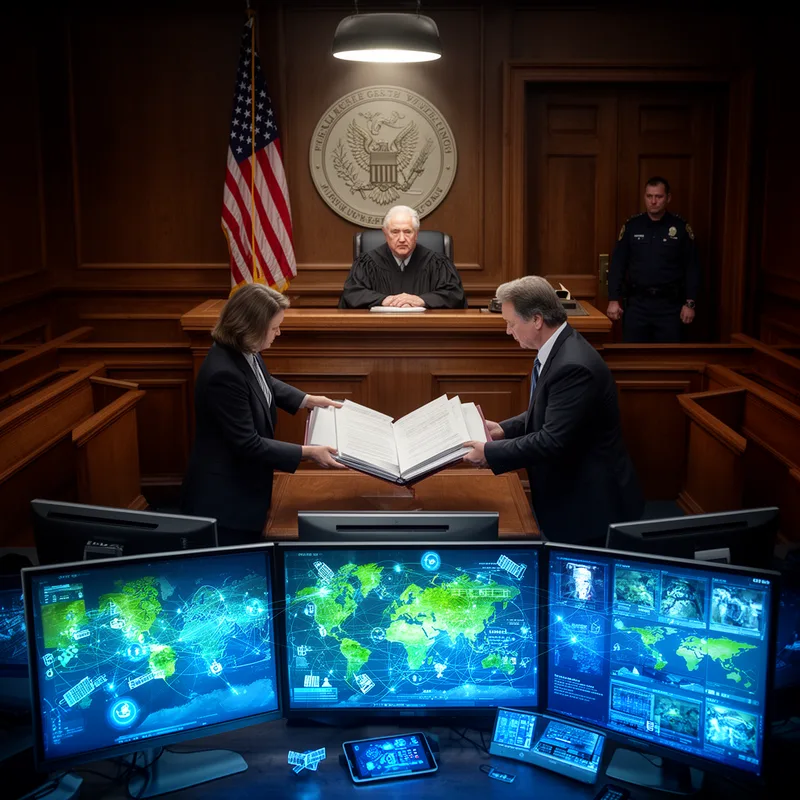
Foreign Intelligence Surveillance Court
 1
9.1
1
9.1

- proper noun
- /ˈfɔrɪn ɪnˈtɛlɪdʒəns sɜrˈveɪləns kɔrt/
- Formal
- order from the Foreign Intelligence Surveillance Court
Examples
-
A recent unclassified report noted that the Foreign Intelligence Surveillance Court has repeatedly held that collection carried out pursuant to the FISA Section 702 minimization procedures used by the government is reasonable under the Fourth Amendment.
Blog text (30) -
Yet a report from Wired this weekend paints a more disturbing picture: National Security Agency surveillance enabled by the FAA was found "unreasonable under the Fourth Amendment" by the secretive Foreign Intelligence Surveillance Court "on at least one occasion."
Blog text (30) -
It is also true that on at least one occasion the Foreign Intelligence Surveillance Court held that some collection carried out pursuant to the Section 702 minimization procedures used by the government was unreasonable under the Fourth Amendment.
Blog text (30) -
The Foreign Intelligence Surveillance Court oversees the government's requests for electronic surveillance.
-
Recent discussions highlighted how the Foreign Intelligence Surveillance Court plays a crucial role in national security.
-
The decisions made by the Foreign Intelligence Surveillance Court are often kept confidential due to the sensitive nature of the cases.
Synonyms
A secret federal court that allows the government to listen to or watch suspected spies
Surface Forms
Morphology
foreign + intelligence + surveillance + court
The phrase is a straightforward descriptive compound: a 'court' concerned with 'surveillance' and 'intelligence' related to 'foreign' matters, so a learner who knows the constituents can infer it is a court that deals with foreign intelligence surveillance. While finer institutional details (e.g. secrecy, authorising electronic surveillance) require background knowledge, the basic referent is directly and compositionally derivable from the parts.
Etymology
The Foreign Intelligence Surveillance Court is a special, mostly secret court that decides when the government can do surveillance, or 'watching', of foreign people or groups to gather intelligence, or 'important safety information'. That's why the court's name explains its job: it can approve secret searches or wiretaps to get that information.