

Finno-Ugric


 1
9.9
- noun
- /ˈfɪnoʊˈʊɡrɪk/
- Specialized
- Its sound structure resembles that of Finno-Ugric languages, and parallels and allusions to her can be found in Finno-Ugrian mythology.
- Finno-Ugric languages
Examples
-
Hungarian is a Finno-Ugric language spoken by millions in central Europe.
-
Finns are culturally similar to Estonians; both languages belong to the Finno-Ugric language group and are unlike most other European languages.
Academic text (2001) -
Hungarian is a Finno-Ugric language.
Blog text (24) -
I speak Estonian, which is closely related to Finnish, and they are part of the difficult Finno-Ugric group of languages.
Blog text (27) -
His volume is divided into two sections: Finno-Ugric and "Siberian," the latter referring to Altaic speakers.
Academic text (1996) -
That ethnographic Finno-Ugric, Siberian, and American Subarctic shamanism are historically related seems indubitable.
Academic text (1996) -
Both Finnish and Estonian are classified as Finno-Ugric languages, sharing common roots.
-
Linguists often study Finno-Ugric languages to understand the linguistic diversity of Eurasia.
Synonyms
 1
9.9
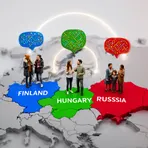
A group of languages spoken in Finland, Hungary, and parts of Russia
Surface Forms
Morphology
Finno-Ugric = Finno + Ugric (opaque) = Finno + Ugric
The term is a specialized linguistic classification not directly derivable from the components without specific knowledge.
Etymology
The word Finno-Ugric combines Finno-, from 'Finland' and 'the Finns', and -Ugric, from a name used for people related to the 'Hungarians', so it names the group of languages that includes Finnish, Estonian and Hungarian.