
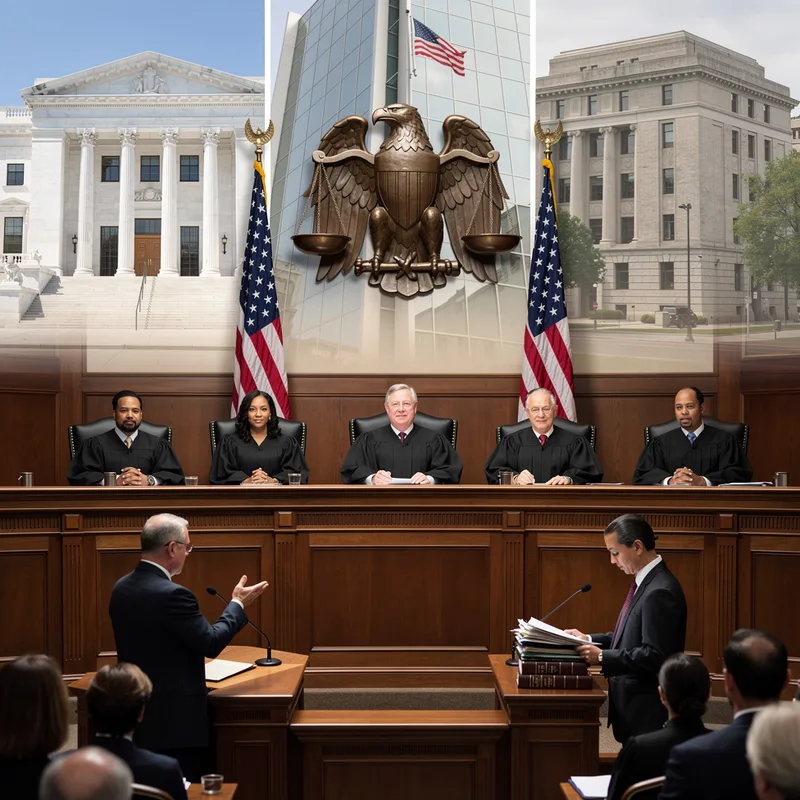
Federal Judiciary
 5
5.4
5
5.4

- noun
- /ˈfɛdərəl dʒuˈdɪʃəri/
- Formal
- Many landmark decisions have been made by the federal judiciary that shaped American society.
- Committee on the Federal Judiciary
- members of the Federal Judiciary
Examples
-
In assessing where these contending forces for and against jurisdiction come to rest, it is useful to remember that the federal judiciary is not a monolith.
Academic text (2017) -
Judges, he says, should also carry smaller caseloads and have research help like their federal judiciary counterparts.
Academic text (2006) -
By the way, the Constitution never grants the Federal judiciary the power to rule on the constitutionality of Federal law.
Blog text (26) -
The third repudiation came from the federal judiciary, and in two stages that sandwiched the House vote.
Academic text (2011) -
Lincoln recognized that Article III of the Constitution created a federal judiciary to resolve disputes, particularly those involving the interpretation of the Constitution.
Academic text (2008) -
While advocacy groups still have a place at the table, they are no longer able to instrumentalize the federal judiciary as an agenda-setting institution.
Academic text (2002) -
Just as important, the two statutory proposals could be challenged under the provision granting life tenure to members of the federal judiciary.
Academic text (2006) -
The federal judiciary has at times officially advocated curtailment of jurisdiction and has lobbied Congress against creating new federal claims.
Academic text (2017) -
The federal judiciary is essential for upholding the Constitution and interpreting laws.
-
The independence of the federal judiciary ensures fair trials and justice for all citizens.
Synonyms
 320
6.5
320
6.5
A system of courts and judges that applies the law in a country
 41
3.9
41
3.9
The courts and judges who use laws to make fair decisions about cases
 7
4.2
7
4.2
The part of government that says what laws mean and decides legal cases

 1
9.9
1
9.9
A system of courts and people who decide legal cases
Surface Forms
Morphology
The meaning is directly compositional: 'federal' specifies the level of government and 'judiciary' denotes the system of courts, so a learner who knows both words can infer it refers to the national-level courts. This is a standard, cross-linguistically common nominal composition and thus readily understandable at B1.
Etymology
Federal Judiciary comes from joining federal (the national government) and judiciary (the group of judges). Picture a group of judges in a national court building deciding cases about country-wide laws, and that's why it means 'the courts that explain and apply federal laws'.