

European wildcat
- noun
- UK
- The European wildcat roams the forests of Europe, often hiding from sight among the underbrush.
Examples
-
Many people do not realize that the European wildcat is the ancestor of our domestic cats.
-
Researchers are studying the European wildcat to better understand its genetics and behavior.
-
Should feral domesticated cats be allowed to mate with threatened European wildcats until the latter can no longer be distinguished from the domesticates (Lecis et al. 2006)?
Academic text (2010)
Synonyms

 49
3.0
49
3.0

A small or medium wild animal like a cat that lives in forests and open fields
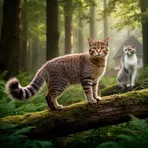
A wild cat with a bushy tail that lives in European forests and that domestic cats come from

A wild cat found in Europe with thick bushy fur and a tail that looks like a large house cat
Surface Forms
Morphology
The meaning 'a wildcat native to Europe' is directly and transparently derived from combining 'European' (related to Europe) with 'wildcat' (a feline living in the wild). This is a straightforward adjective + noun composition common across languages, so a B1 learner who knows both constituents will readily understand the MWE.
Etymology
European wildcat is the name for a 'wild' cat from Europe. Imagine a shy cat with a thick, bushy tail living in the forest that looks like a house cat but is untamed. That picture explains why it is called European and wildcat, and why people think it is the 'ancestor' of the domestic cat.