
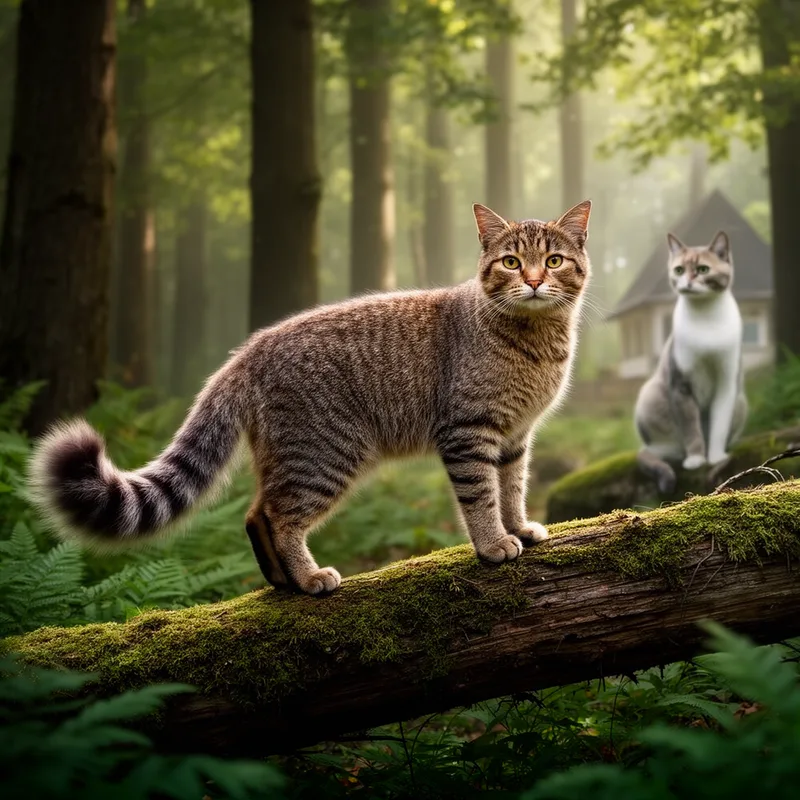
Felis silvestris
- noun
- Specialized
- Unlike domestic cats, the Felis silvestris has a bushy tail and is fully adapted to life in the wild.
Examples
-
Some scientists believe the domestic cat descended from the Felis silvestris.
-
The Felis silvestris is often found in forests across Europe.
-
Habitat loss has made the Felis silvestris population increasingly vulnerable in parts of Europe.
-
The Felis silvestris is rarely seen in the dense forests where it lives.
-
Did you know that the Felis silvestris is the ancestor of domestic cats?
-
The Felis silvestris roams the forests of Europe, where it hunts small mammals.
-
Researchers are studying the Felis silvestris to understand its role in the ecosystem.
Synonyms

A wild cat that lives in European forests and has a bushy tail

A wild cat found in Europe with thick bushy fur and a tail that looks like a large house cat
Surface Forms
Morphology
Felis + silvestris
The name is compositionally built from a genus label 'Felis' (a cat) plus the Latin epithet 'silvestris' (literally 'of the woods' — cognate with Romance 'silvestre'), so a learner who knows both constituents can infer a forest- or wild-associated cat. However, the use of Latin taxonomic naming and the specialized species-level sense means the exact meaning ('wildcat' or ancestor of the domestic cat) is somewhat specialized and not fully predictable for an average B1 learner.
Etymology
Felis silvestris comes from the Latin words felis meaning 'cat' and silvestris meaning 'of the woods'. So the name gives a simple image of a 'wild cat' living in the woods, which is why it refers to the wild European cat and the ancestor of the domestic cat.

