
Euphorbia lathyris
- noun
- Specialized
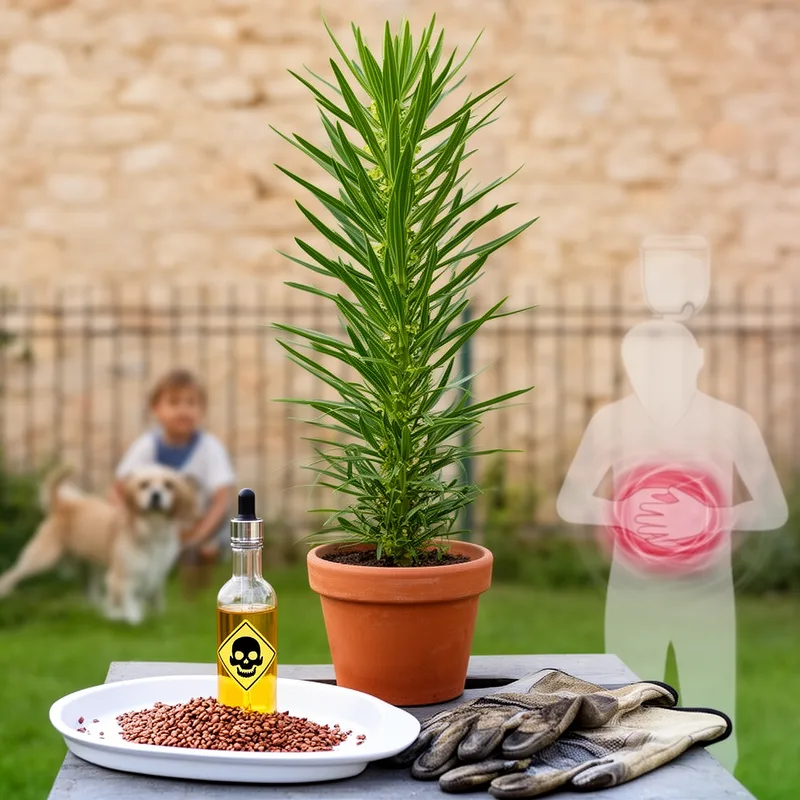
- The seeds of Euphorbia lathyris are known to yield an oil with strong purgative effects.
Examples
-
Gardeners sometimes plant Euphorbia lathyris to deter moles from their lawns.
-
Due to its toxicity, Euphorbia lathyris should be handled with care and kept away from children.
-
The Euphorbia lathyris plant can be found in many gardens.
-
Many gardeners avoid Euphorbia lathyris due to its toxicity.
-
Due to its toxicity, Euphorbia lathyris should be handled with care and kept away from children.
-
The seeds of Euphorbia lathyris are known to yield an oil with strong purgative effects.
-
Gardeners sometimes plant Euphorbia lathyris to deter moles from their lawns.
Synonyms

A garden plant that is poisonous and grown to keep moles away

A poisonous plant with milky sap whose seeds have an oil once used as a laxative
Surface Forms
Morphology
Euphorbia + lathyris
This is a scientific binomial: the genus name Euphorbia signals it is a plant (so a learner who knows that genus could infer 'a kind of Euphorbia plant'), but the species epithet 'lathyris' has no independent, transparent meaning and does not convey the poisonous/mole-plant properties. Taxonomic naming is cross-linguistically patterned (genus + species), giving partial predictability, but the specific descriptive meaning of the full name is not derivable from the constituents alone.
Etymology
Euphorbia lathyris may come from an old doctor named Euphorbus who used similar plants as strong medicine. The second word, lathyris, was an old name for a seed plant, which fits because this plant has strong seeds and oil and is known today as a 'poisonous' 'mole plant'.

