

Euphorbia amygdaloides
- noun
- UK
 :
Euphorbia amygdaloides
:
Euphorbia amygdaloides
- Gardeners appreciate Euphorbia amygdaloides for its attractive evergreen foliage and yellow flower clusters.
Examples
-
Euphorbia amygdaloides is often found in shady woodland areas throughout Europe.
-
The Euphorbia amygdaloides blooms beautifully in spring.
-
Botanists recorded several new populations of Euphorbia amygdaloides in the national park.
-
Look at that Euphorbia amygdaloides!
-
Euphorbia amygdaloides thrives in shaded areas, making it a popular choice for woodland gardens.
-
In the wild, Euphorbia amygdaloides can be spotted along forest edges and in damp meadows.
-
Many people find Euphorbia amygdaloides fascinating due to its unique greenish-yellow flower clusters.
Synonyms
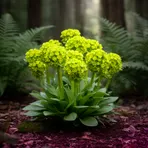
A perennial woodland plant with greenish-yellow flower clusters
Surface Forms
Morphology
Euphorbia + amygdaloides
This is a scientific Latin binomial: even if a learner knows 'Euphorbia' as a plant genus, 'amygdaloides' is a non‑English, dictionary‑absent form whose contribution to meaning is not transparent to a B1 learner. The compound is a specialized, lexicalized taxonomic name whose referent ('wood spurge', a particular perennial herb) cannot be predicted from the surface constituents without botanical or lexical knowledge.
Etymology
Euphorbia amygdaloides gets its name from two simple images: the first part Euphorbia may come from an old doctor named Euphorbus who used a similar plant as medicine, and the second part amygdaloides means 'almond-like' because parts of the plant look like small almonds. So the name points to a spurge that grows in woods and has almond-shaped parts, which is why people call it 'wood spurge'.

