
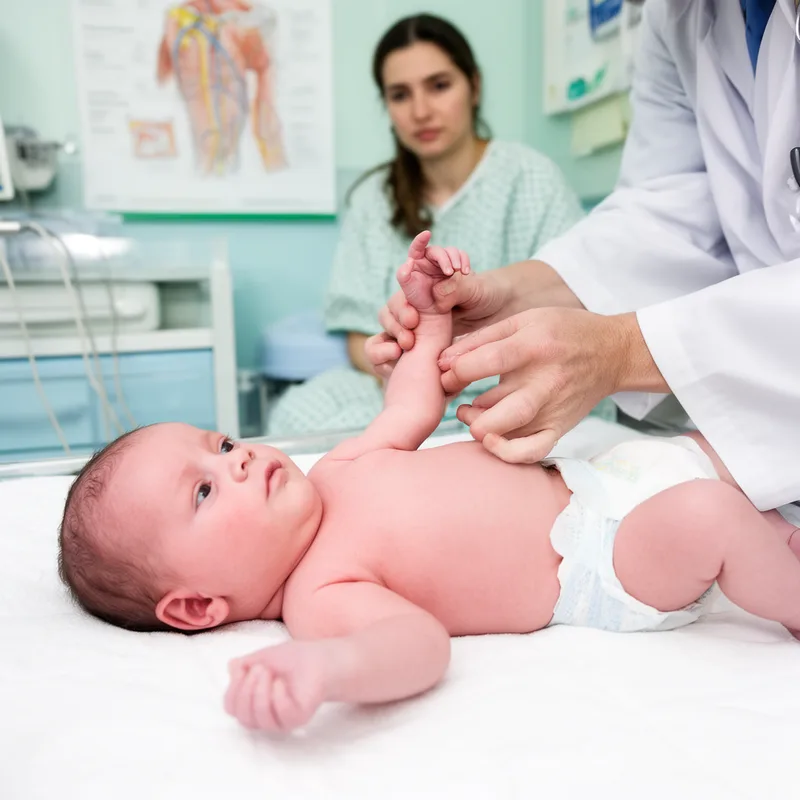
Erb-Duchenne paralysis
- noun
- /ˈɜrb dʌˈʃɛn pəˈrælɪsɪs/
- Specialized
- The infant was diagnosed with Erb-Duchenne paralysis after a difficult delivery.
Examples
-
Physical therapy is often recommended for children with Erb-Duchenne paralysis to improve mobility.
-
Many infants recover from Erb-Duchenne paralysis with therapy.
-
Early intervention can greatly help in the recovery of those suffering from Erb-Duchenne paralysis.
-
The baby suffered from Erb-Duchenne paralysis after birth.
-
Physical therapy is often recommended for children with Erb-Duchenne paralysis to improve mobility.
-
Early intervention can greatly help in the recovery of those suffering from Erb-Duchenne paralysis.
-
The infant was diagnosed with Erb-Duchenne paralysis after a difficult delivery.
Synonyms

Weakness and loss of feeling in an arm caused by nerve injury during birth
Surface Forms
Morphology
Erb-Duchenne + paralysis
The noun 'paralysis' makes it clear to a learner that the phrase denotes a form of loss of movement, so they will grasp that it is a type of paralysis. However, 'Erb-Duchenne' is an eponymic medical name that does not transparently indicate the affected body part (arm) or the causal mechanism (brachial plexus injury during childbirth), so the full, specific meaning cannot be predicted from the constituents.
Etymology
Erb-Duchenne paralysis is named after two doctors, Wilhelm Erb and Guillaume Duchenne, who first described a nerve injury that makes the 'arm' weak. So, the name refers to a type of 'arm' paralysis often seen after a difficult 'birth'.

