
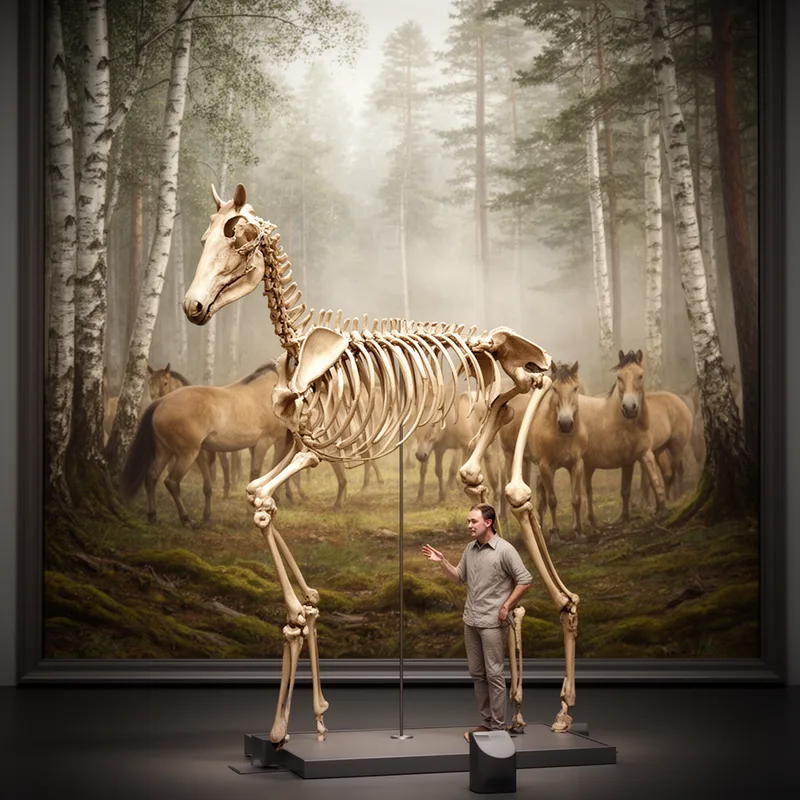
Equus caballus gomelini
- noun
- Specialized
 :
Equus caballus gomelini
:
Equus caballus gomelini
- The Equus caballus gomelini once roamed the forests of Eastern Europe before its extinction.
Examples
-
Scientists have studied Equus caballus gomelini to understand the impact of human activity on wild horse populations.
-
Fossils of Equus caballus gomelini provide insight into the biodiversity of early 20th-century Europe.
-
The Equus caballus gomelini was a unique subspecies of horse.
-
Did you know that Equus caballus gomelini is now extinct?
-
The Equus caballus gomelini was a subspecies of horse known for its adaptation to the cold climates of Eastern Europe.
-
Once a common sight in the wilderness, the Equus caballus gomelini became extinct due to habitat loss and hunting.
-
Research on the Equus caballus gomelini has helped scientists learn how human development can threaten wildlife.
Synonyms


 1
9.9
1
9.9
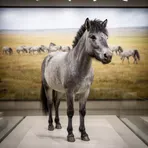
A small gray wild horse from eastern Europe and western Asia that is now extinct
Surface Forms
Morphology
Equus + caballus + gomelini
The Latin binomial partly reveals the referent: 'Equus'/'caballus' signal a horse taxon so a learner who knows those roots could infer it names a kind of horse. However the full meaning (that it is a specific subspecies, its geographic scope, and that it became extinct) cannot be derived from the proper-name epithet 'gomelini' or from taxonomic labeling alone. Because only the general category (horse) is transparent while the specific identity and extinction information are not predictable from the parts, this is best classified as semi-transparent.
Etymology
Equus caballus gomelini is a Latin scientific name that literally names a kind of horse: Equus and caballus both mean 'horse', and gomelini likely comes from a person named Gomelin who first described it. So the name points to that particular wild horse subspecies, which later became 'extinct' and died out in the early 20th century.