

Egyptian henbane
- noun
- Specialized
- Researchers extract alkaloids like hyoscyamine from Egyptian henbane for pharmaceutical purposes.
Examples
-
Egyptian henbane has long been used in traditional medicine for its sedative effects, despite its toxicity.
-
The garden was carefully labeled to warn visitors about the dangerous Egyptian henbane growing near the path.
-
The Egyptian henbane is known for its toxic properties.
-
Farmers should avoid planting Egyptian henbane near crops.
-
The garden was carefully labeled to warn visitors about the dangerous Egyptian henbane growing near the path.
-
Researchers extract alkaloids like hyoscyamine from Egyptian henbane for pharmaceutical purposes.
-
Egyptian henbane has long been used in traditional medicine for its sedative effects, despite its toxicity.
Synonyms

 1
9.9
1
9.9

A poisonous herb with sticky, hairy leaves and yellowish brown flowers
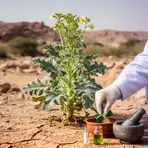
A poisonous plant from North Africa and the Middle East with leaves that contain a drug used in traditional medicine

A group of poisonous plants like henbane that belong to the nightshade family
Surface Forms
Morphology
This is a straightforward compositional noun phrase: 'Egyptian' simply localizes the noun 'henbane', and 'henbane' already denotes a poisonous herb. A B1 learner who knows both words will infer it means a henbane associated with Egypt, so the overall meaning is directly derivable and cross-linguistically transparent.
Etymology
Egyptian henbane comes from the older parts hen and bane and was seen as 'killer of hens' because chickens often died if they ate the plant. So the name is a simple memory hook: it is a poisonous herb that was used carefully in medicine.