
Duchenne's muscular dystrophy
- noun
- /djuːˈʃɛnɪz ˈmʌskjələr dɪsˈtrɔfi/
- Specialized
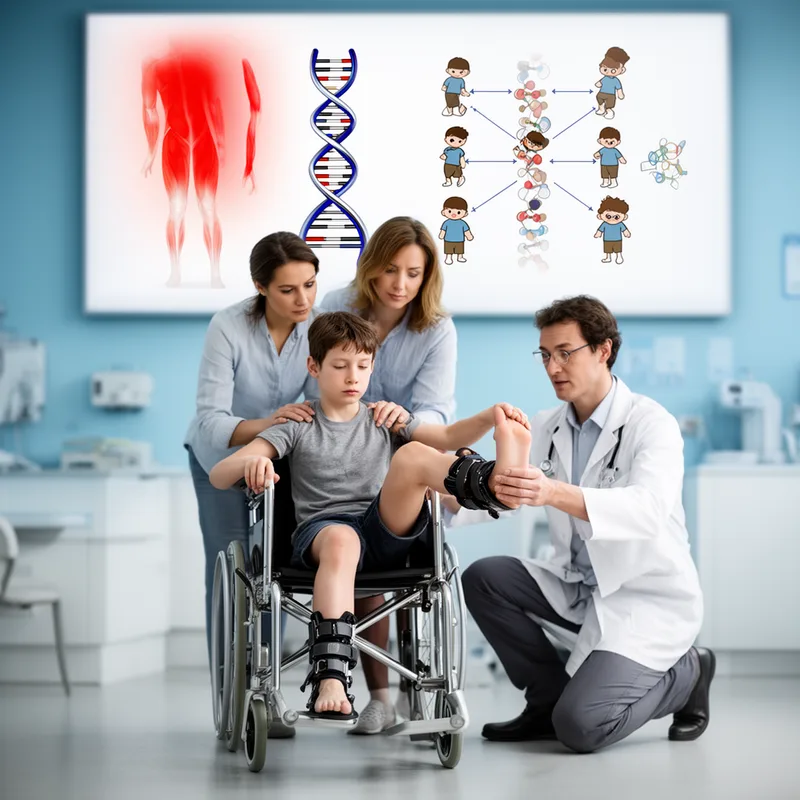
- The doctor explained that Duchenne's muscular dystrophy is a severe genetic disorder that primarily affects boys.
Examples
-
The doctor explained that Duchenne's muscular dystrophy is a genetic disorder usually diagnosed in early childhood.
-
Many boys diagnosed with Duchenne's muscular dystrophy require physical therapy.
-
Families affected by Duchenne's muscular dystrophy often seek support to manage the progressive symptoms.
-
Researchers are working to find better treatments for Duchenne's muscular dystrophy to improve quality of life for patients.
-
Is Duchenne's muscular dystrophy hereditary?
-
Families affected by Duchenne's muscular dystrophy often seek support to manage the progressive symptoms.
-
Many boys diagnosed with Duchenne's muscular dystrophy require physical therapy to help maintain their mobility.
Synonyms

A disease that makes muscles look large but weak and mostly affects boys
How Severe
- Specialized

- Specialized
Surface Forms
Morphology
Duchenne's + muscular + dystrophy
The core phrase 'muscular dystrophy' is compositional — a learner who knows 'muscular' (relating to muscles) and 'dystrophy' (progressive muscle wasting) can infer it is a muscle-wasting disorder. However, 'Duchenne's' is an eponymic modifier that indicates a specific, severe X‑linked subtype mostly affecting boys; that clinical specificity is not derivable from the constituent words alone, so full meaning requires prior medical knowledge.
Etymology
Duchenne's muscular dystrophy is named after the French doctor Guillaume Duchenne, who first described boys who had severe 'muscle weakness' that got worse over time. That's why the name points to this specific 'disease' of the muscles that is passed down in families.

