
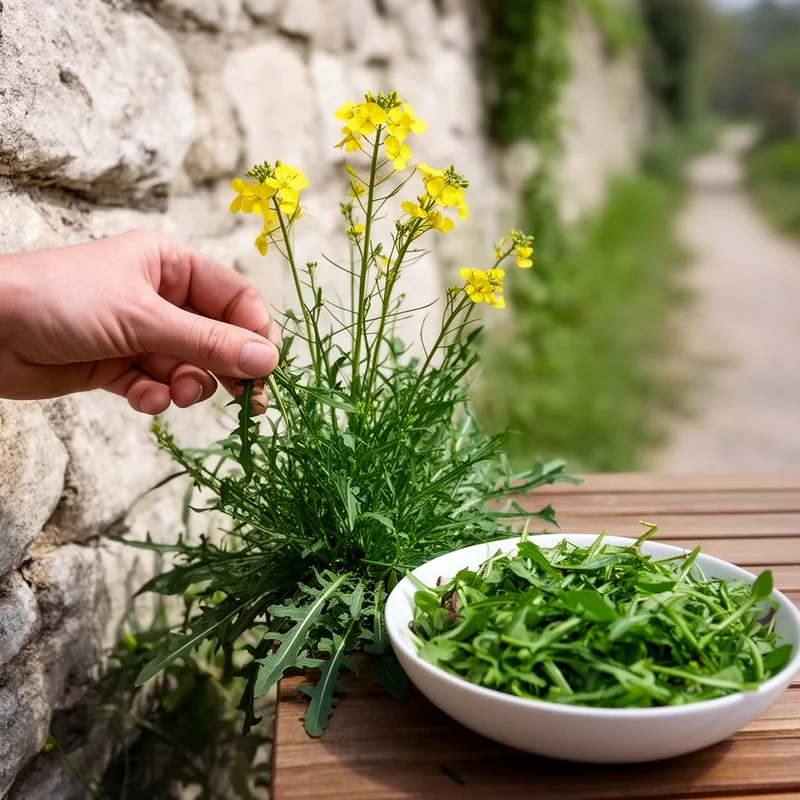
Diplotaxis tenuifolia
- noun
- Specialized
- The fresh leaves of Diplotaxis tenuifolia are often added to salads for their peppery flavor.
Examples
-
Botanists conducted a survey of Diplotaxis tenuifolia growing on the ancient city walls.
-
In some regions, Diplotaxis tenuifolia has become a troublesome invasive plant along roadsides and in gardens.
-
The Diplotaxis tenuifolia is often found in rocky areas.
-
Many gardeners consider Diplotaxis tenuifolia a weed.
-
Many gardeners consider Diplotaxis tenuifolia a weed in their vegetable plots due to its vigorous growth.
-
In some regions, Diplotaxis tenuifolia has become a troublesome invasive plant along roadsides and in gardens.
-
The fresh leaves of Diplotaxis tenuifolia are often added to salads for their peppery flavor.
Synonyms

A plant with yellow flowers that grows on old walls and in empty places

A small plant with bright yellow flowers that often grows in cracks on old walls

A wild weed with small yellow flowers and spicy leaves
Surface Forms
Morphology
Diplotaxis + tenuifolia
This is a Latin binomial (scientific) name whose meaning ('wild rocket' or a particular mustard-family plant) is not transparently built from English words a B1 learner would know. 'Diplotaxis' is technical and 'tenuifolia' is a Latin botanical epithet (meaning 'thin‑leaved') that learners typically do not recognize, so the species name functions as an arbitrary label rather than a compositional phrase.
Etymology
Diplotaxis tenuifolia comes from Greek and Latin words that describe how the plant looks: Diplotaxis means 'double' or 'two rows', referring to its seed pods, and tenuifolia means 'thin leaves'. So the name helps you remember the plant: think thin, peppery leaves and pods in two rows.

