
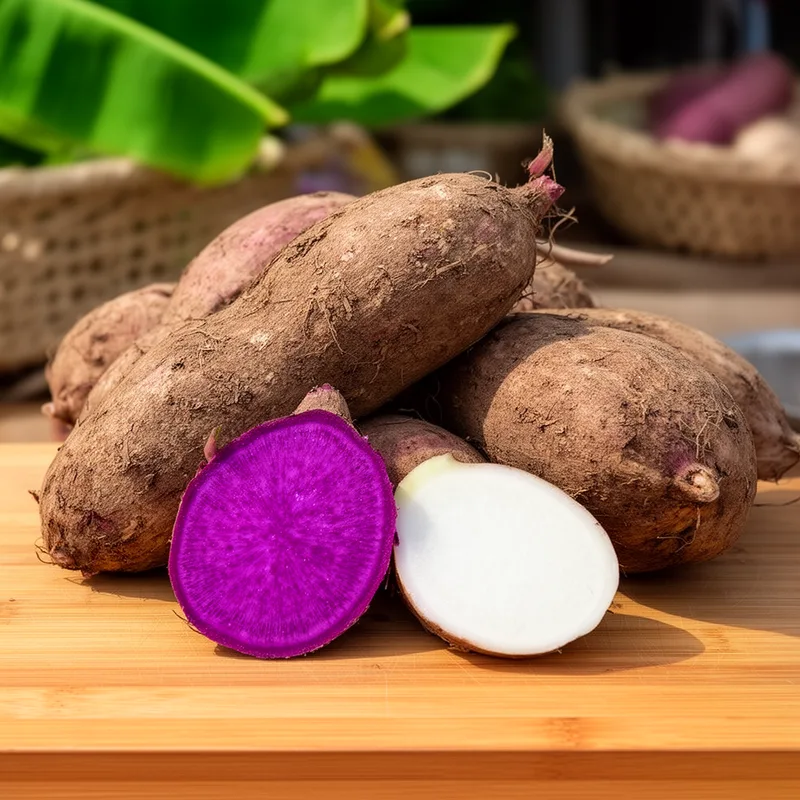
Dioscorea alata
- noun
- Specialized
- Dioscorea alata is commonly known as the purple yam in many Southeast Asian cuisines.
Examples
-
Farmers in Polynesia have long relied on Dioscorea alata for its high-yielding, nutritious tubers.
-
The distinctive color of some varieties of Dioscorea alata makes them popular in desserts and ice cream.
-
The Dioscorea alata is often called purple yam.
-
Many people enjoy Dioscorea alata in desserts.
-
Dioscorea alata is widely cultivated in Southeast Asia for its large, edible tubers that are often used in traditional dishes.
-
In Southeast Asian markets, Dioscorea alata can be found alongside other local vegetables, prized for its starchy texture.
-
Many chefs appreciate Dioscorea alata for its unique flavor, which enhances both savory and sweet recipes.
Synonyms

A large starchy root with white flesh used for cooking
A large root vegetable grown on Pacific islands with soft white inside
Surface Forms
Morphology
Dioscorea + alata
This is a Linnaean binomial combining the genus name 'Dioscorea' (a tropical genus of yams) with a species epithet; a learner who knows those constituents will readily infer it denotes a specific kind of Dioscorea (i.e. a species of yam with the described tuber). Taxonomic name formation is compositional and cross-linguistically recognizable, and even if the Latin adjective 'alata' is not fully transparent semantically, its role as an identifier makes the overall meaning predictable.
Etymology
Dioscorea alata gets its name from two parts: Dioscorea probably honors an old Greek doctor, Dioscorides, who wrote about plants, and alata is a Latin word meaning 'winged', used for thin, wing-like parts on the stem or leaf. So the name helps you remember this particular yam, the starchy and sometimes purple edible root it refers to.

