

Digitalis purpurea
- noun
- /ˌdɪdʒɪˈtælɪs pərˈpjʊəriə/
- Specialized
- Gardeners often warn that Digitalis purpurea is toxic if ingested by pets or livestock.
Examples
-
The leaves of Digitalis purpurea are used to make an important heart medication.
-
In early summer, Digitalis purpurea brightens woodland edges with its towering purple spikes.
-
The Digitalis purpurea plant can grow up to two meters tall.
-
Farmers should be cautious of Digitalis purpurea around livestock.
-
The Digitalis purpurea, commonly known as foxglove, has beautiful pink-purple flowers that attract many pollinators.
-
Farmers need to ensure that livestock do not graze on Digitalis purpurea because its leaves are poisonous.
-
In herbal medicine, Digitalis purpurea is valued for its cardiac properties, helping to regulate heart rhythm.
Synonyms
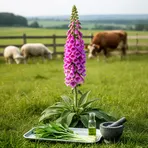
A tall European plant with clusters of pink-purple tube flowers whose leaves make heart medicine and can poison farm animals

A tall garden plant with large pink-purple tube-shaped flowers and leaves poisonous to animals

A tall plant with large pink-purple tube flowers whose leaves are poisonous but make heart medicine

A tall leafy plant with large pink-purple flowers that has leaves poisonous to livestock and used for heart medicine
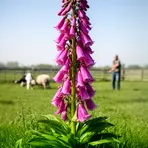
A tall plant with clusters of large pink-purple tube-like flowers and leaves poisonous to farm animals
Surface Forms
Morphology
Digitalis + purpurea
This is a standard botanical binomial combining the genus name 'Digitalis' (a group of bell-shaped flowering plants) with the Latin epithet 'purpurea' (meaning 'purple'), so the compound transparently denotes the purple-flowered Digitalis species. Because the meaning follows regular compositional and cross-linguistically recognizable Latin adjectival naming, a learner who knows the constituents can infer it refers to a purple/pink Digitalis plant.
Etymology
Digitalis purpurea gets its name from a Latin word for 'finger' because Digitalis flowers are tube-shaped and look like little fingers or a glove, and purpurea means 'purple'. People make a 'heart medicine' from its leaves, but the same leaves are also 'poisonous' to animals, so gardeners warn about it.

