
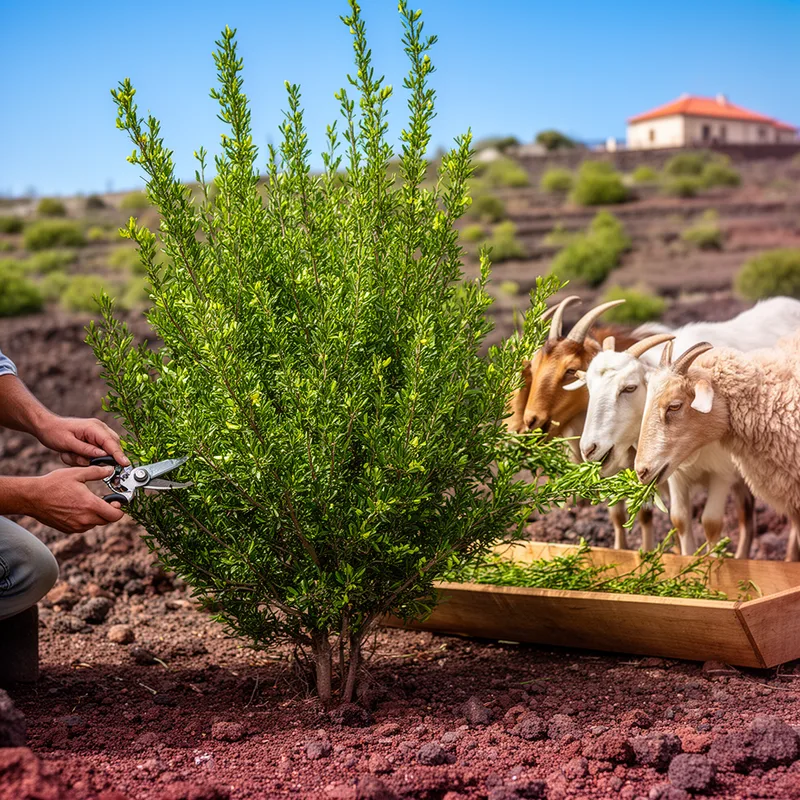
Cytisus proliferus
- noun
- Specialized
- Farmers often grow Cytisus proliferus for cattle fodder.
Examples
-
The Cytisus proliferus shrub has adapted well to poor soils and arid climates.
-
Farmers in the Canary Islands rely on Cytisus proliferus to feed their livestock during dry seasons.
-
Researchers are studying Cytisus proliferus for its potential to improve sustainable agriculture.
-
The Cytisus proliferus is commonly found in the Canary Islands.
-
Farmers in the Canary Islands rely on Cytisus proliferus to feed their livestock during dry seasons.
-
Many ranchers cultivate Cytisus proliferus as it provides important fodder for their cattle.
-
The robust growth of Cytisus proliferus makes it a valuable resource for livestock during droughts.
Synonyms



 1
9.9
A bush from the Canary Islands that farmers use to feed cows
A shrub from the Canary Islands that farmers grow to feed animals
Surface Forms
Morphology
Cytisus + proliferus
This is a binomial Latin species name (a proper label) rather than a compositional English phrase; such botanical names are referential and not predictably built from everyday English vocabulary. The second element 'proliferus' is not a known English word here, and even if learners recognised a link to 'proliferate' the specific sense and the geographic/cultivation information would not be derivable, so a B1 learner would not reliably infer the full meaning from the parts.
Etymology
Cytisus proliferus is named for how it looks and grows: the part Cytisus refers to a broom-like bush and proliferus means 'grows a lot'. Because this plant sends out many shoots and makes plenty of leaves, farmers used it 'to feed' cattle, so the name helps you remember it as a shrub used for animal food.