
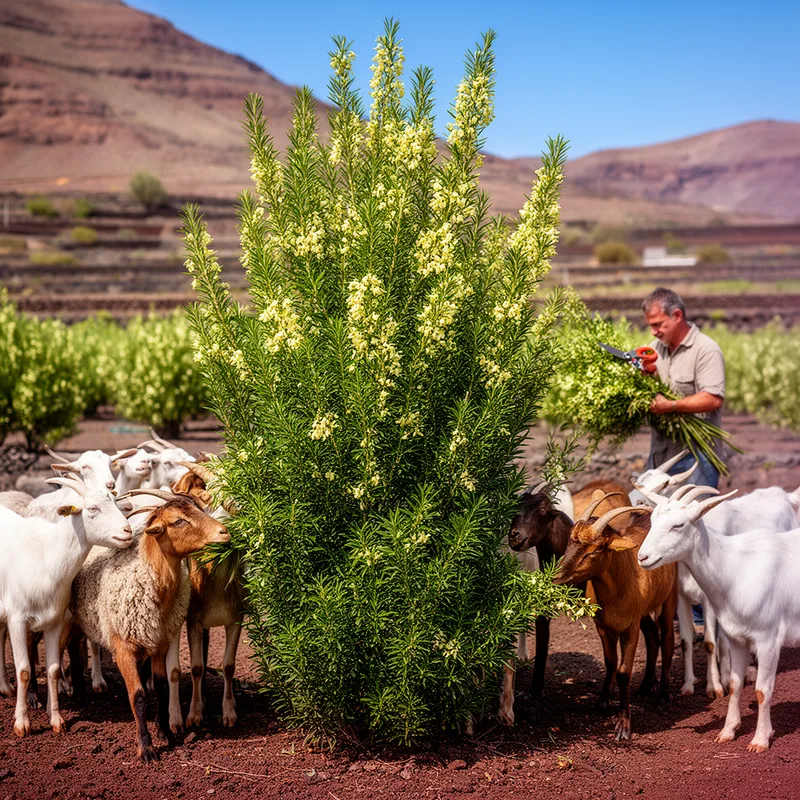
Chamaecytisus palmensis
- noun
- Specialized
- Chamaecytisus palmensis is often grown on farms in the Canary Islands to feed livestock.
Examples
-
Some farmers value Chamaecytisus palmensis for its drought resistance and high nutritional content.
-
Researchers are studying the benefits of planting Chamaecytisus palmensis as a sustainable fodder crop.
-
The Chamaecytisus palmensis is commonly found in the Canary Islands.
-
Farmers in the region often use Chamaecytisus palmensis as fodder.
-
Chamaecytisus palmensis is cultivated primarily as a nutrient-rich fodder for cattle in the Canary Islands.
-
Many farmers choose to plant Chamaecytisus palmensis because it is an excellent source of feed for livestock.
-
The shrub Chamaecytisus palmensis thrives in dry conditions and is often harvested for animal fodder.
Synonyms


 1
9.9
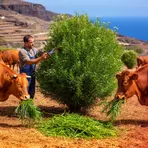
A bush from the Canary Islands that farmers use to feed cows
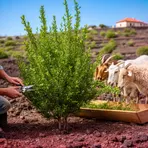
A small bush from the Canary Islands that people use to feed farm animals
Surface Forms
Morphology
Chamaecytisus + palmensis
This is a transparent scientific binomial: the genus name 'Chamaecytisus' denotes a group of plants, and the specific epithet 'palmensis' (though not listed in the dictionary) is a common Latin formation meaning 'from La Palma' or 'of Palma'. If a B1 learner knows the genus label and the toponymic sense of 'palmensis', they can directly infer it names a species of Chamaecytisus native to/associated with La Palma (Canary Islands).
Etymology
Chamaecytisus palmensis may come from old Greek and a place name: Chamae- means 'low' and cytisus is a small broom-like shrub, while palmensis means 'from La Palma'. So the name gives a clear image of a low, broom-like shrub from La Palma, which explains why this plant is a Canary Islands shrub used as cattle fodder.