
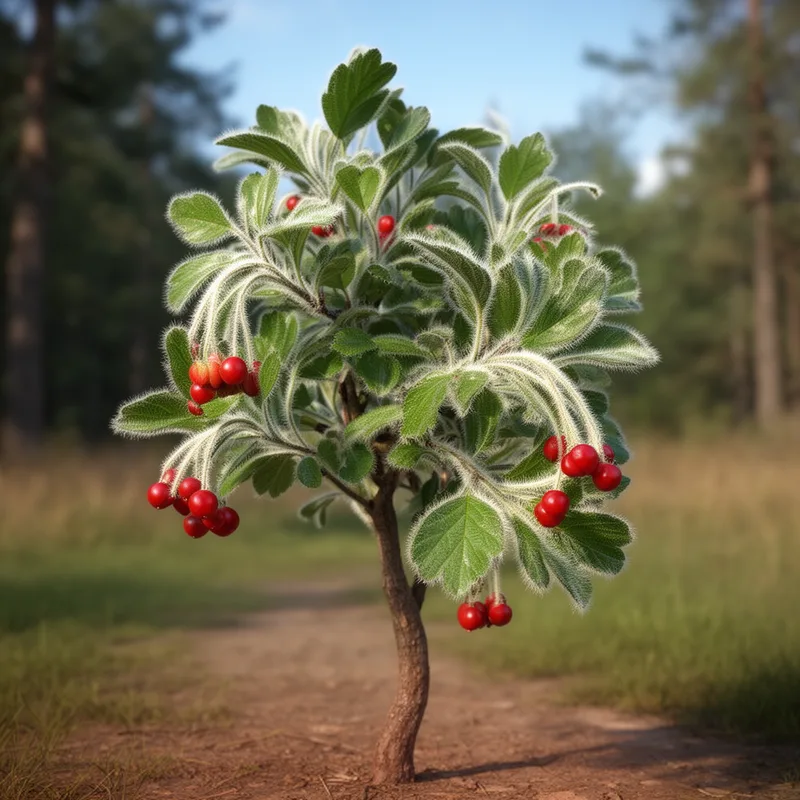
Crataegus mollis
- noun
- Specialized
- The Crataegus mollis is admired for its dense, woolly foliage and bright red berries in autumn.
Examples
-
Gardeners in the Midwest often choose Crataegus mollis for its ornamental qualities and resilience.
-
During our hike, we identified a Crataegus mollis growing near the path by its unique hairy leaves.
-
The Crataegus mollis is often found in moist woodlands.
-
Have you ever seen a Crataegus mollis tree?
-
During our hike, we identified a Crataegus mollis with striking red fruit and dense, furry leaves.
-
Gardeners in the Midwest appreciate Crataegus mollis for its beautifully woolly leaves and lovely red berries.
-
The Crataegus mollis is known for its small red fruits and unique, hair-covered stems that attract attention.
Synonyms

A small tree with red berries and soft hairy leaves and stems
A small American tree with red fruit and soft hairy leaves
Surface Forms
Morphology
Crataegus + mollis
This is a Latin binomial (scientific) name: 'Crataegus' indicates a genus of hawthorns but 'mollis' is Latin and not a common English word (and is listed as not found), so a B1 learner who only knows ordinary English words would not be able to derive the specific species meaning or the trait description. Understanding this MWE requires botanical/Latin knowledge rather than transparent composition from everyday English constituents, so it is not comprehensible to typical B1 learners.
Etymology
Crataegus mollis comes from old Greek and Latin words: Crataegus from a Greek word meaning 'strong' (because the wood is very hard) and mollis from Latin meaning 'soft' (for the tree's woolly, hairy leaves). So the name gives a clear image of this hawthorn — hard wood but soft, fuzzy leaves and red berries — which is why it fits this species.

