
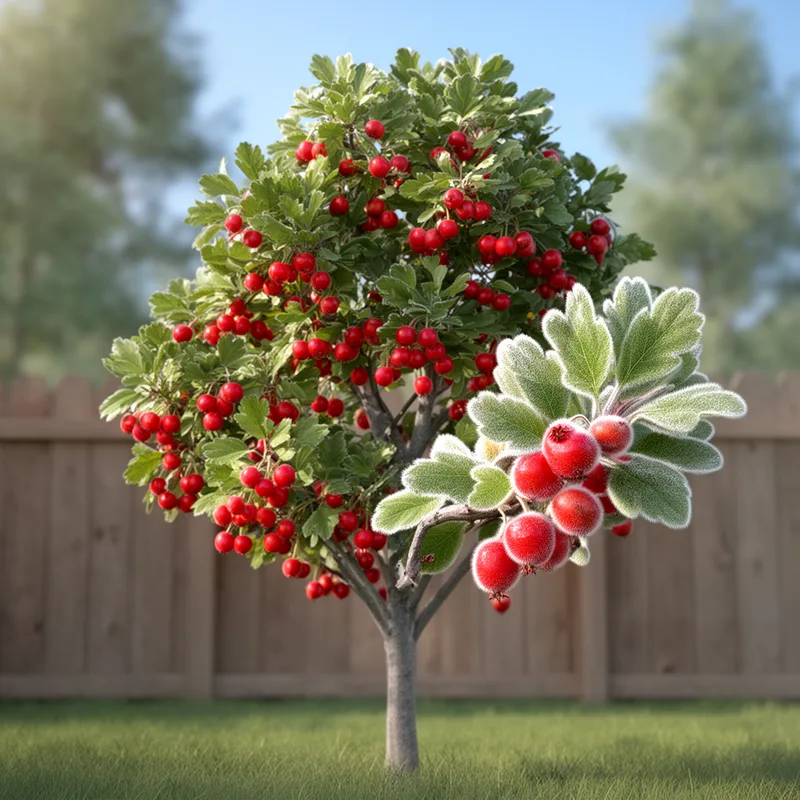
Crataegus coccinea mollis
- noun
- Specialized
- Gardeners often choose Crataegus coccinea mollis for its attractive red fruit and woolly foliage.
Examples
-
The Crataegus coccinea mollis thrives in well-drained soils throughout the eastern United States.
-
I planted a Crataegus coccinea mollis in my backyard last spring.
-
Researchers are studying Crataegus coccinea mollis to better understand its resistance to certain plant diseases.
-
The Crataegus coccinea mollis is known for its vibrant red fruit.
-
Gardeners often choose Crataegus coccinea mollis for its attractive red fruit and dense woolly leaves.
-
The Crataegus coccinea mollis thrives in well-drained soils throughout the eastern United States.
-
I planted a Crataegus coccinea mollis in my backyard last spring because I love its bright red berries.
Synonyms
A North American small tree with red berries and very hairy leaves and stems

A small tree with red berries and soft hairy leaves and stems
Surface Forms
Morphology
Crataegus + coccinea + mollis
This is a scientific Latin plant name (genus + species + variety) whose specific senses rely on botanical/Latin vocabulary rather than everyday English composition. An average B1 learner—even if they recognise 'Crataegus' as a genus—will not know the Latin epithets 'coccinea' and 'mollis' or be able to derive the detailed meaning (red-fruited, woolly-haired), so the overall meaning is not predictable from the parts.
Etymology
Crataegus coccinea mollis comes from old words: Crataegus means 'hard' for its tough wood, coccinea means 'scarlet' for the bright red fruit, and mollis means 'soft' for the woolly leaves and stems. So the name simply describes a hawthorn with hard wood, red berries, and soft, fuzzy leaves.

