

Coriolis effect
 1
8.4
1
8.4

- noun
- /ˌkɔːriˈoʊlɪs ɪˈfɛkt/
- Specialized
- As the air flows away from the poles, it is turned to the west by the Coriolis effect.
Examples
-
The earth's rotation causes the Coriolis effect, which deflects massive air and water flows toward the right in the Northern Hemisphere and toward the left in the Southern Hemisphere.
-
He said he knew that winds around low pressure cells in the Northern Hemisphere rotate counterclockwise, but did not understand how the Coriolis effect was involved in all wind circulations.
Blog text (18) -
If it were not for the Coriolis effect, the wind would blow straight into the eye of a hurricane, and there would be no circulation.
Blog text (18) -
The cause of the Coriolis effect is the Earth's rotation.
Blog text (18) -
These winds attempt to move in a straight line, but are always deflected by the Coriolis effect.
Blog text (18) -
The result of the Coriolis effect is that wind directions in the Northern Hemisphere are deflected to the right, while those in the Southern Hemisphere are deflected to the left.
Blog text (18) -
Due to the counterbalancing action of the atmospheric pressure gradients and the Coriolis effect, sea ice drifts roughly parallel to the frictionless wind above the surface, at about 1% of its speed.
Academic text (2011) -
The other great heat mover is the Coriolis effect, which moves colder water from the polar regions to equatorial regions, displacing warmer equatorial waters in the direction of the polar regions.
Blog text (9) -
These winds attempt to move in a straight line, but are always deflected by the Coriolis effect.
Synonyms
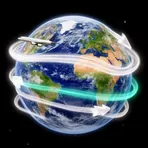
A push that makes moving things curve on a rotating body like Earth
Surface Forms
Morphology
Coriolis + effect
While 'effect' signals a result, 'Coriolis' is an eponymic proper name referring to a specific physical mechanism; a B1 learner who only knows the individual words would not be able to infer the specialised meaning (the apparent deflection in a rotating frame). This is a technical, non-compositional term named after a scientist, so its meaning is not derivable from the constituents.
Etymology
Coriolis effect is a name that comes from a clear image: imagine standing on a spinning carousel and throwing a ball straight ahead, and to you on the carousel the ball 'seems to curve' away. That's why the Coriolis effect describes how winds and currents on a turning Earth 'appear to turn' instead of going straight.