
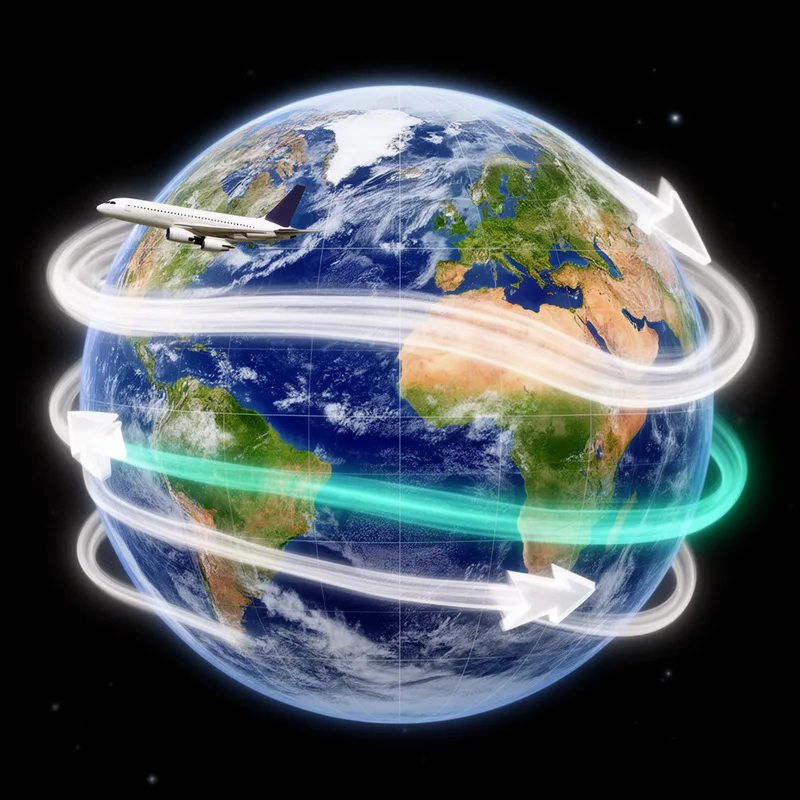
Coriolis force
- noun
- /ˌkɔːriˈoʊlɪs fɔːrs/
- Specialized
- Just before the neon totally obscured everything, Tern saw that the small motions had combined into a spinning weather system, driven by the heat at its center and Aello's not insignificant Coriolis force.
Loading YouTube…
Watch on YouTubeBut then as soon as it gets moving, it feels the Coriolis force and it'll begin to bend.
- But then as soon as it gets moving, it feels the Coriolis force and it'll begin to bend.
Examples
-
The Coriolis force causes weather systems to rotate in specific directions depending on the hemisphere.
-
This tower of water, heavy clouds, begins to spin because of the Coriolis force that draws in more air, which extracts more heat from the ocean, which drives the cycle.
-
And you get everything else here for the strength of the Coriolis force questions there.
-
What's more, there are the effects of the Coriolis force.
Fiction book (2001) -
But then as soon as it gets moving, it feels the Coriolis force and it'll begin to bend.
-
So the Coriolis force, what's it got to do with the angular momentum?
-
For example, if this center of mass gets beneath the surface of the Sun, then the motion of solar plasma beneath the solar surface would be affected: the absence of the Coriolis force would disable the regular solar cycle and it would bring solar minimum.
Blog text (20) -
Psychological or perceptual glitches, akin to the mild imbalance caused by the Coriolis force.
Fiction book (2001) -
In meteorology, the Coriolis force plays a crucial role in the formation of hurricanes as it influences the rotation of air around low-pressure areas.
-
Understanding the Coriolis force is essential for predicting the path of ocean currents and wind patterns on Earth.
Synonyms

 1
8.4
1
8.4

A curved path that moving air or water appear to follow because the Earth turns
Surface Forms
Morphology
Coriolis + force
The phrase pairs the proper name 'Coriolis' (which carries no lexical meaning for learners) with the known noun 'force', so a B1 learner could infer it denotes some kind of force but would not be able to derive the specific idea of apparent deflection in rotating systems. Because the key technical content is eponymous and domain-specific rather than compositional, the expression is only partially transparent.
Etymology
Coriolis force is named after a French scientist, Gaspard-Gustave de Coriolis, who showed how motion looks strange on a turning surface. Imagine throwing a ball straight across a spinning carousel: the ball seems to curve because the floor turns under it, and that simple image explains why the term means the way winds and currents 'curve' on the turning Earth.