

Copernican system
 1
6.9
1
6.9

- noun
- /kəˈpɜrnɪkən ˈsɪstəm/
- Specialized
- Opposed to the Copernican system for religious reasons, yet fully cognizant of the growing anomalies in the Ptolemaic model, he fashioned a grand compromise.
Examples
-
Many astronomers rejected the Copernican system because it contradicted traditional beliefs about the cosmos.
-
At the time it was proposed and for many years thereafter, the Copernican system did not work as well as the Ptolemaic system.
Academic text (1991) -
These are not obscure passages, and their literal sense would obviously have to be abandoned if the Copernican system were true.
Blog text (2) -
In 1633, Galileo was tried by the Inquisition in Rome and forced to abjure his belief in the sun-centered Copernican system.
Academic text (1995) -
Galileo defended the Copernican system, arguing that the Earth revolves around the sun.
-
The Copernican system revolutionized our understanding of the universe by placing the sun at the center.
Synonyms
 1
8.4
1
8.4
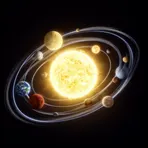
The idea that the Sun is at the center of the solar system and the planets move around it


 1
8.0
1
8.0
The idea that the Sun is at the center and planets move around it

A model that puts the sun at the center of the solar system
Surface Forms
Morphology
The phrase is fully compositional: 'Copernican' denotes something relating to Copernicus's sun-centred theory and 'system' denotes a model or organized set of components, so together they straightforwardly mean the astronomical model proposed by Copernicus. Although 'Copernican' is historically specific, a learner who knows both constituents can derive the MWE's meaning without prior exposure.
Etymology
Copernican system is named after the astronomer Nicolaus Copernicus, who suggested that the Earth and other planets 'revolve around' the sun instead of the Earth being the center. That's why the term refers to the 'system' or model where the sun is at the center.