
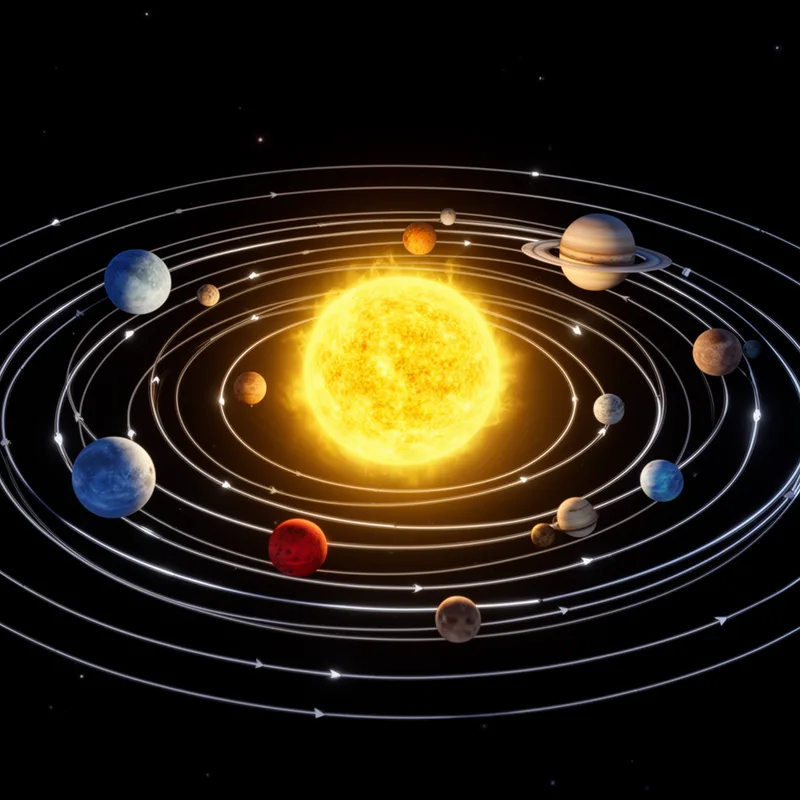
Copernican
 1
8.1
1
8.1

- adjective
- /kəˈpɜrnɪkən/
- Specialized
- The Copernican theory represents a pivotal moment in scientific history, reshaping humanity's perspective of the universe.
- Copernican revolution
- Copernican cosmology
- Copernican view
Loading YouTube…
Watch on YouTubeI mean, the Copernican revolution was one that's that the Earth is not the centre of the universe.
- I mean, the Copernican revolution was one that's that the Earth is not the centre of the universe.
Examples
-
In the Copernican view, planets revolve around the sun, contrasting with older geocentric theories.
-
An example of this, the law of parsimony, was operating in the ultimate triumph of the heliocentric Copernican theory over the older geocentric Ptolemaic theory.
Academic text (1990) -
Yet the Copernican revolution can also be understood in a much wider and more significant sense.
Academic text (1990) -
The humbling progression that began with the Copernican revolution is not yet over.
Academic text (2000) -
The Copernican revolution dislodged humans from the center of creation.
Academic text (2000) -
Five centuries ago, the first Copernican revolution dislodged humankind from our privileged position at the center of the universe.
Academic text (2006) -
The paradigm shift in science from Ptolemaic to Copernican cosmology is clearly reflected in post-Enlightenment theology.
Academic text (2009) -
Galileo Galilei faced the Inquisition over his embrace of the Copernican solar system and his own research stemming from it.
Academic text (2017) -
Descartes was, in this sense, the crucial midpoint between Copernicus and Kant, between the Copernican revolution in cosmology and the Copernican revolution in epistemology.
Academic text (1990) -
The Copernican model dramatically changed our understanding of the solar system by placing the sun at its center.
Synonyms
 1
8.1
1
8.1
Having the sun as the center of the solar system, with planets moving around it
Compounds

Surface Forms
Morphology
Copernican = Copernicus (transparent) = Copernicus + an
Formed directly from the proper name Copernicus with the productive adjectival suffix -an; a learner who knows Copernicus will readily understand the relation.
Etymology
Copernican comes from the name of the scientist Copernicus, who put the 'Sun at the center' of the solar system instead of Earth. So Copernican describes ideas about that model where the planets go around the Sun.