
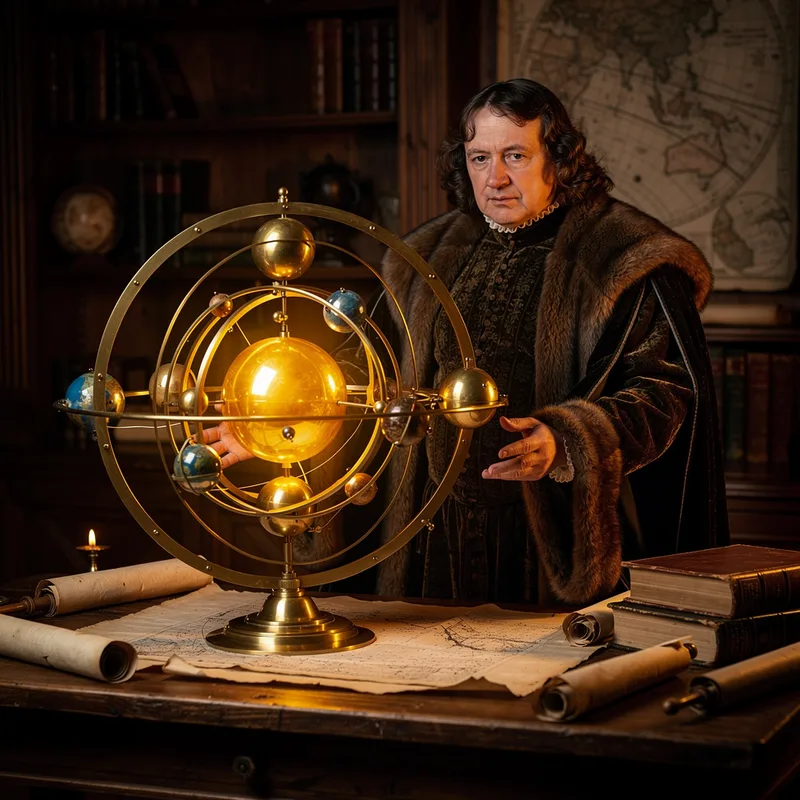
Copernicus
 9
6.8
9
6.8

- proper noun
- /kəˈpɜrnɪkəs/
- In 1543, Nicolaus Copernicus published his revolutionary book that shifted the view of the cosmos.
- Nicolaus Copernicus
- Copernicus's heliocentric theory
- Copernicus's solar model
Loading YouTube…
Watch on YouTubeThey did not quite have the the Copernicus model with the sun in the middle.
- They did not quite have the the Copernicus model with the sun in the middle.
- And the first blow was Copernicus said we are not at the center of the universe.
- And that was what when Oceander writes the preface to Rate de Revolucioni was to try and keep Copernicus out of trouble with the Church, right.
- All of a sudden things started to make sense and Giordano Bruno, a theologian, was put to death for suggesting that Copernicus was right.
- It was before Copernicus's view about the heliocentric, geocentric version of the universe.
- That's a really interesting and profound, you know, kind of that's almost like Copernicus saying, you know, the world rolls around the sun, not vice versa, right?
- We really still in a, I'll talk about the sort of great revolutions in thinking and triggered by people like Copernicus.
- And then along comes a guy named Copernicus ran the numbers and said, actually the math says it's more likely that we are going around the sun.
- But you can achieve a degree in science without knowing who Copernicus was.
Examples
-
However, neither Copernicus nor Kepler could determine the absolute size of the planetary radii.
Academic text (2006) -
Imagine you live in the 16th century, when Copernicus discovers that Earth orbits the Sun.
Academic text (1992) -
This is the greatest scientific discovery since Copernicus.
-
His work was based upon that of Copernicus, as was that of Kepler.
Blog text (10) -
In 1543, Copernicus published his sun-centered model of the solar system.
Academic text (2006) -
Aristarchus and Copernicus are often regarded as the originators of the heliocentric system of the planets.
Academic text (2003) -
In 1543, Nikolaus Copernicus published De Revolutionibus Orbium Coelestium, which set the stage for the development of modern scholarship.
Academic text (2005) -
Many consider Copernicus the father of modern astronomy for introducing the heliocentric model.
-
The ideas of Copernicus laid the groundwork for future astronomers like Galileo and Kepler.
Synonyms
A Polish astronomer who proposed that the Earth and other planets move around the sun
Surface Forms
Etymology
Copernicus is the Latin form of the Polish family name Kopernik, which may come from a word meaning 'copper' or from koper 'dill'. He used this Latin name as many scholars did, and we know him today for his sun-centred idea.