
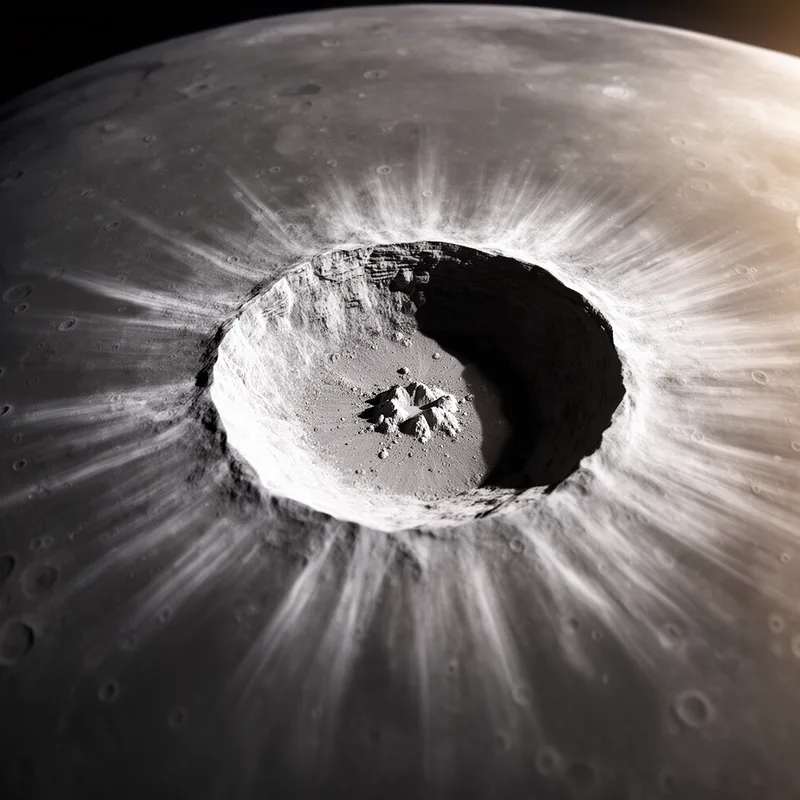
Copernicus
 2
7.7
2
7.7

- proper noun
- Always check the histogram to make sure you're not overexposing any of the bright crater ray areas like Tycho or Copernicus.
- Copernicus crater
Examples
-
Copernicus...
-
In Holden's words, "every feature which we see in the crater Copernicus seems to have its analogue, if not its counterpart, on this small island of Hawaii."
Academic text (2004) -
These remarkable views show the crater Copernicus.
-
The last two ghosts went to Copernicus and Aristarchus.
Fiction book (1996) -
It appeared to be landing at Copernicus, one of the sites proposed for further Apollo missions before the last three had been canceled.
Fiction book (1996) -
Or it could wait until he reached the Moon before fading out, just as the last two had done: the first over Copernicus and the second over the Aristarchus plateau.
Fiction book (1996) -
He attributed the ejecta blanket, a ring of rough terrain that surrounds Copernicus, to lava flows.
Academic text (2004) -
He argued, for example, that the terraced inner rim of Copernicus was reminiscent of terraces found within the caldera of Kilauea.
Academic text (2004) -
Although Holden was mistaken about the origin of lunar craters like Copernicus, it would be churlish to impugn him too harshly on this matter, as many other astronomers thought similarly.
Academic text (2004) -
These remarkable views show the crater Copernicus on the Moon.
Surface Forms
Etymology
Copernicus is the name of a lunar crater and it was named after the astronomer Copernicus. His surname is the Latin form of the Polish Kopernik, which may come from a word meaning 'copper' or from koper 'dill', and the crater uses his name because his work changed how we see the sky.