
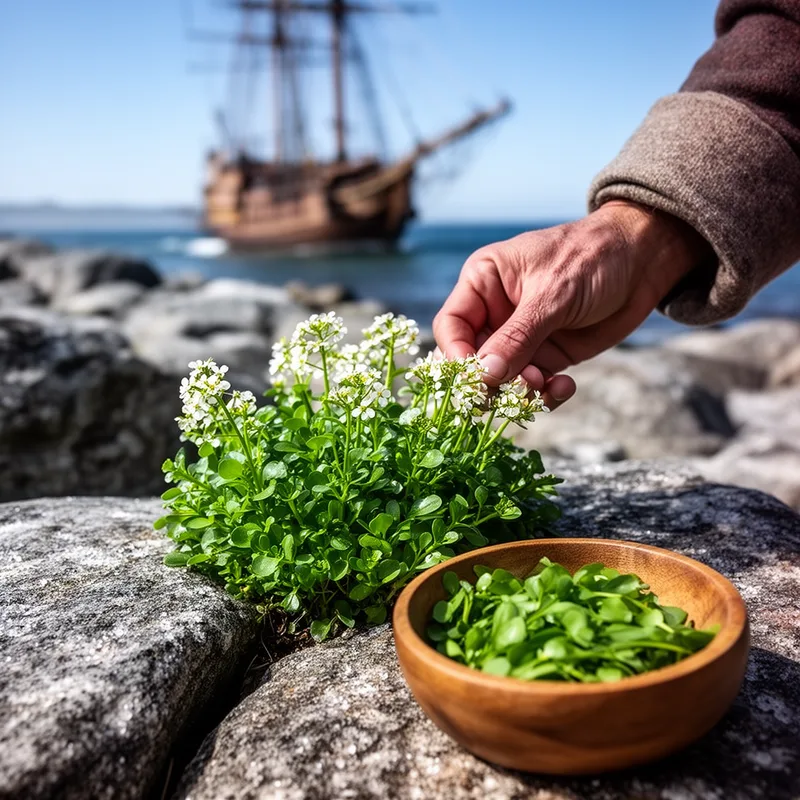
Cochlearia officinalis
- noun
- Specialized
- Herbalists once recommended Cochlearia officinalis to help prevent scurvy during long sea voyages.
Examples
-
In Arctic regions, Cochlearia officinalis grows abundantly along rocky shores.
-
Researchers studied Cochlearia officinalis for its vitamin C concentration and its historical role in sailors' diets.
-
Look at this Cochlearia officinalis!
-
I found some Cochlearia officinalis growing near the coast.
-
Herbalists once recommended Cochlearia officinalis to help prevent scurvy due to its high vitamin C content.
-
Researchers studied Cochlearia officinalis for its role in preventing scurvy in sailors during long voyages.
-
In Arctic regions, Cochlearia officinalis grows abundantly and is known for its use in treating scurvy.
Synonyms
A small plant with edible leaves high in vitamin C that sailors used to prevent scurvy

A small coastal plant with yellow flowers high in vitamin C
Surface Forms
Morphology
Given the provided constituent meanings, the compound is directly interpretable: 'Cochlearia' names a vitamin C–rich coastal mustard plant and 'officinalis' is a conventional Latin epithet meaning 'medicinal' or 'used in pharmacopeia', so together they denote a medicinal Cochlearia (scurvy‑grass). Botanical Latin binomial patterns like this are consistent across languages and follow predictable compositional rules, so a learner who knows the parts can infer the MWE meaning.
Etymology
The plant Cochlearia officinalis has a name that gives a clear image. Cochlearia may come from a word for 'spoon' because its leaves are spoon-shaped, and officinalis marked plants used as 'medicine'. Sailors ate its sour leaves full of vitamin C to prevent 'scurvy', so the name helps you remember it is the old medicinal 'scurvy-grass'.

