
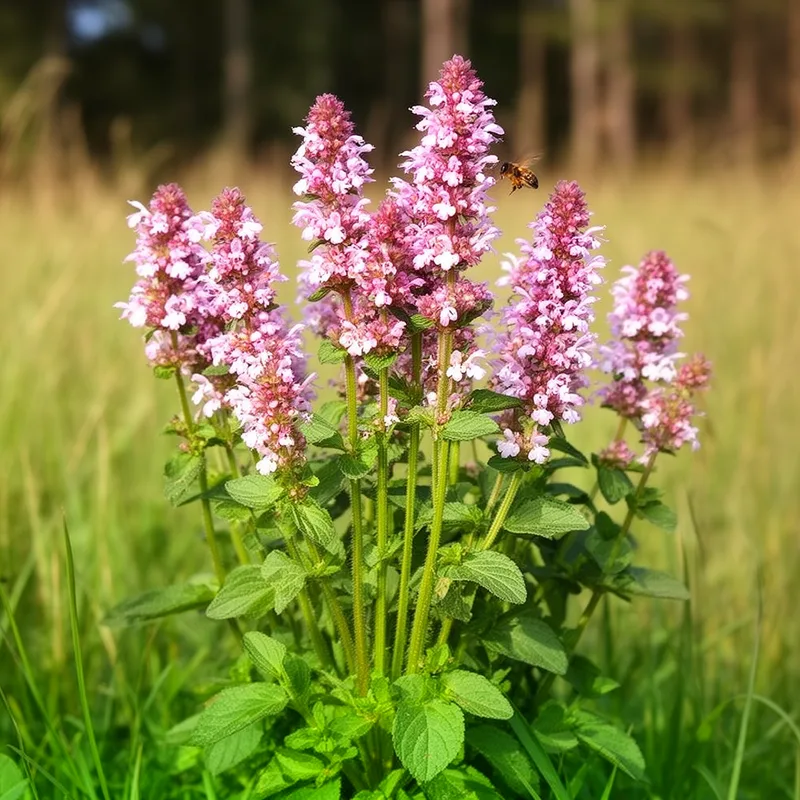
Clinopodium vulgare
- noun
- Specialized
- Gardeners enjoy planting Clinopodium vulgare for its attractive pink flower clusters.
Examples
-
The leaves of Clinopodium vulgare can be used as a mild herbal tea.
-
Many people use Clinopodium vulgare in their gardens to attract pollinators with its fragrant blooms.
-
Clinopodium vulgare thrives in meadows and woodland edges across Europe.
-
I found some Clinopodium vulgare growing in my garden.
-
The Clinopodium vulgare has beautiful pink flowers.
-
Clinopodium vulgare is often used in traditional herbal remedies due to its aromatic properties.
-
In the wild, Clinopodium vulgare can be found growing abundantly in sunny, open areas.
Synonyms

A small aromatic herb with pink or white flowers used in cooking
A fragrant herb with small bunches of pink or white flowers

An aromatic herb with small pink or white flowers that grows in meadows and gardens
Surface Forms
Morphology
Clinopodium + vulgare
This is a scientific Latin binomial combining the genus name 'Clinopodium' with a species epithet; if a learner knows the genus and recognizes that 'vulgare' corresponds to Latin for 'common', they can infer it denotes a species of Clinopodium (the 'common' Clinopodium). However, binomial nomenclature and Latin epithets are domain-specific and not standard English composition, and 'vulgare' is not an everyday English word, so the meaning is not fully predictable for an average B1 learner without prior exposure.
Etymology
Clinopodium vulgare is a scientific plant name, and the second part vulgare means 'common'. So the name simply labels the ordinary wild basil you find in fields and woods and that people use as a mild tea.

