
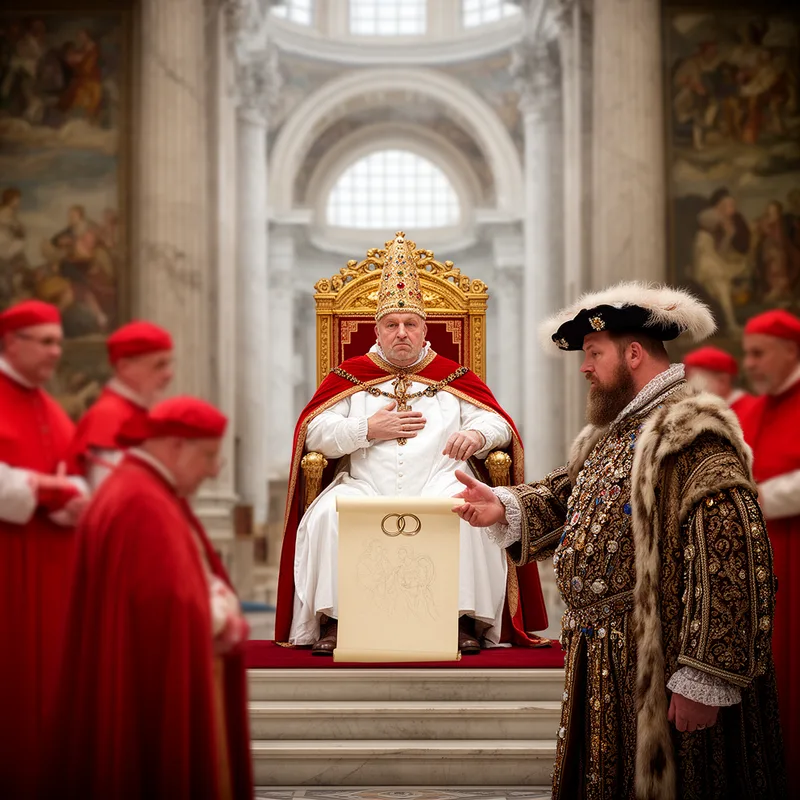
Clement VII


 1
8.9
- proper noun
- Pope Clement VII ruled from 1523 to 1534 and is remembered for his conflicts with Henry VIII.
Examples
-
Pope Clement VII ruled from 1523 to 1534.
-
The refusal of Clement VII to annul Henry VIII's marriage led to England's split from Rome.
-
During his reign, Clement VII faced the sack of Rome by Charles V's troops.
-
Historians often debate the political strategies of Clement VII during the turbulent Reformation period.
-
Did Clement VII approve of Henry VIII's divorce?
-
The refusal of Clement VII to annul Henry VIII's marriage caused significant religious upheaval in England.
-
Historians often discuss the actions of Clement VII during the Reformation, particularly regarding his dealings with England.
Synonyms
 1
9.2
An Italian pope 1523 to 1534 who refused Henry VIII's divorce and caused England to leave the Catholic Church

An Italian pope who ruled as Clement VII from 1523 to 1534
Surface Forms
Morphology
Clement + VII
The sequence 'Clement VII' transparently conveys 'Clement the Seventh' because 'Clement' is a name and 'VII' is a Roman numeral indicating the seventh, a cross-linguistic convention for numbered rulers. However, the specific identity as the pope who reigned 1523–1534 (and related biographical details) is encyclopedic world knowledge that cannot be derived from the constituent words alone, so the expression is only partially predictable to learners.
Etymology
The name Clement VII shows two things: Clement means 'merciful' in Latin and VII means he was the seventh pope with that name. He was pope from 1523 to 1534 and is remembered for refusing to cancel Henry VIII's marriage, a choice that helped lead England to break away from the Catholic Church.