
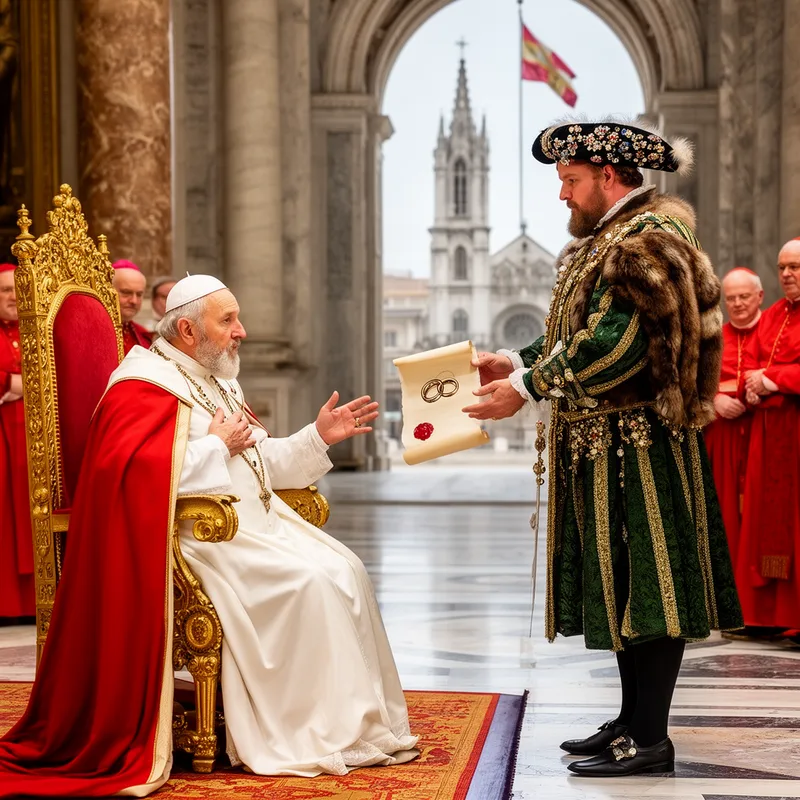
Pope Clement VII


 1
9.2
- proper noun
- Pope Clement VII refused to annul Henry VIII’s marriage to Catherine of Aragon, leading to England's break with Rome.
Examples
-
During his papacy, Pope Clement VII faced the sack of Rome by imperial troops in 1527.
-
Historians often discuss how Pope Clement VII's decisions influenced the course of European history.
-
During the reign of Pope Clement VII, the Protestant Reformation gained momentum.
-
Did Pope Clement VII really deny Henry VIII's divorce?
-
Pope Clement VII was significant in the schism that led to the Church of England's formation.
-
The policies of Pope Clement VII played a crucial role during the political upheavals of the 16th century.
-
Many writings analyze the challenges faced by Pope Clement VII during the Reformation period.
Synonyms
 1
8.9
The pope of the Roman Catholic Church from 1523 to 1534 who refused Henry VIII's request to end his marriage

An Italian pope who ruled as Clement VII from 1523 to 1534
Surface Forms
Morphology
This is a referential, compositional name: 'Pope' (head of the Church) + 'Clement' (personal name) + 'VII' (the seventh) yields the straightforward meaning 'the seventh pope named Clement'. The phrase is not idiomatic or metaphorical and follows cross‑linguistic naming conventions, so a B1 learner who knows the constituent words (and basic Roman numerals) will grasp the basic meaning even if they lack historical details.
Etymology
Pope Clement VII was the pope who famously said 'no' when King Henry VIII asked him to cancel his marriage, a decision that helped cause England to break away from the Catholic Church. He also suffered the violent 'sack of Rome' in 1527, so today his name is remembered for those dramatic events and their big impact on European history.