

Claudio Monteverdi


 1
7.9
- proper noun
- /ˈklaʊdioʊ mɒntəˈvɜrdi/
- Scholars praise Claudio Monteverdi for blending Renaissance polyphony with new Baroque styles.
Examples
-
Many musicologists consider Claudio Monteverdi the father of opera for his pioneering works in the genre.
-
The madrigals of Claudio Monteverdi are often performed by early music ensembles today.
-
The famous composer Claudio Monteverdi changed the course of music history.
-
Did Claudio Monteverdi really compose the first opera?
-
Many musicologists consider Claudio Monteverdi the father of opera for his pioneering works in the genre.
-
Scholars praise Claudio Monteverdi for blending Renaissance polyphony with new Baroque styles.
-
The madrigals of Claudio Monteverdi are often performed by early music ensembles today.
Synonyms
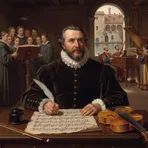 1
9.3
An Italian composer who helped change music from the Renaissance to the Baroque era
Surface Forms
Morphology
Claudio + Monteverdi
This is a proper name referring to a specific historical individual; the biographical meaning ('an Italian composer marking the transition from Renaissance to Baroque') cannot be compositionally derived from the constituent name-parts. Knowing the words 'Claudio' and 'Monteverdi' (even if familiar as names) does not allow a B1 learner to infer the specific identity or historical role, so the expression is idiomatic/lexical rather than transparent.
Etymology
Claudio Monteverdi was an Italian composer around 1600 who acted like a musical bridge between the older Renaissance music and the newer Baroque style. Because he mixed the old many-voice music with more dramatic, emotional sounds and helped create the first operas, people call him the 'father of opera' and a 'bridge' between the two periods.