
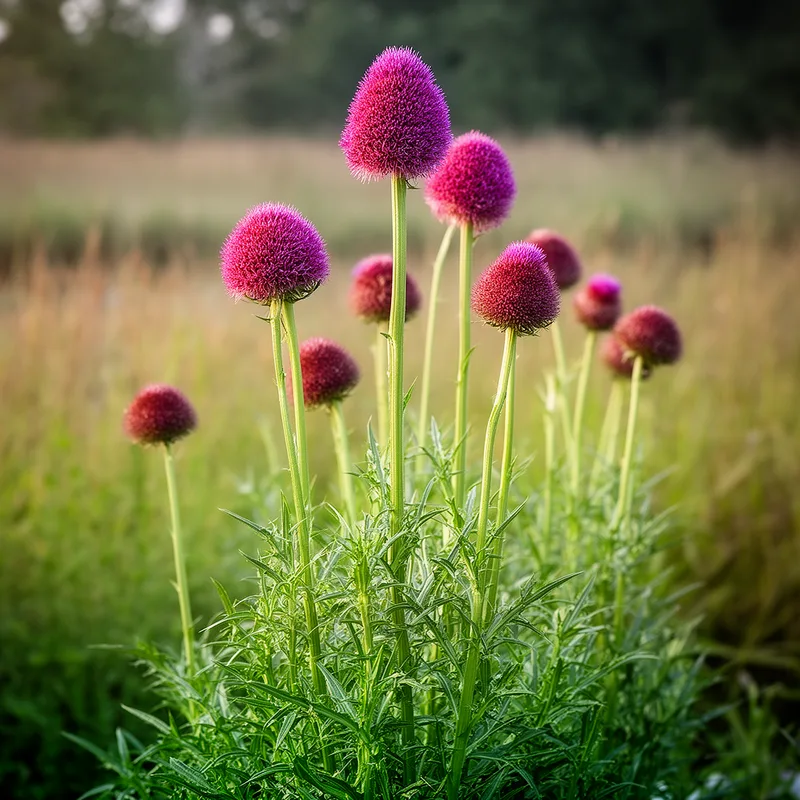
Cirsium rivulare
- noun
- Specialized
 :
Cirsium rivulare
:
Cirsium rivulare
- In summer, Cirsium rivulare attracts many pollinators with its vibrant purple-red flower heads.
Examples
-
Gardeners often cultivate Cirsium rivulare for its striking purple flowers and attractive appearance.
-
The wetlands in Poland are a natural habitat for Cirsium rivulare.
-
Unlike some thistles, Cirsium rivulare is well-behaved and does not aggressively spread in gardens.
-
Look at that stunning Cirsium rivulare over there!
-
The Cirsium rivulare blooms beautifully in the summer.
-
Gardeners often cultivate Cirsium rivulare for its striking purple flowers and attractive appearance.
-
The wetlands in Poland provide an ideal environment for Cirsium rivulare, allowing it to flourish.
Synonyms

A thistle that grows near streams and wet meadows in central and southwestern Europe
Surface Forms
Morphology
Cirsium + rivulare
The form is a Latin binomial (genus + specific epithet), so a learner who knows 'Cirsium' (a thistle genus) and the epithet could infer this names a species of Cirsium, but the detailed meaning (tall stature, purple-red heads, native range) is not recoverable from the parts. Latin scientific naming is a cross-linguistic convention that gives partial compositional information (that it is a type of thistle) but not the full descriptive senses, so comprehension is only partial for a B1 learner.
Etymology
Cirsium rivulare may come from old words that describe the plant: Cirsium may come from a word meaning 'swollen vein', a name once used for thistles, and rivulare means 'small stream' because this thistle often grows in damp places. So, the name helps you picture a tall, purple thistle that likes wet ground.

