
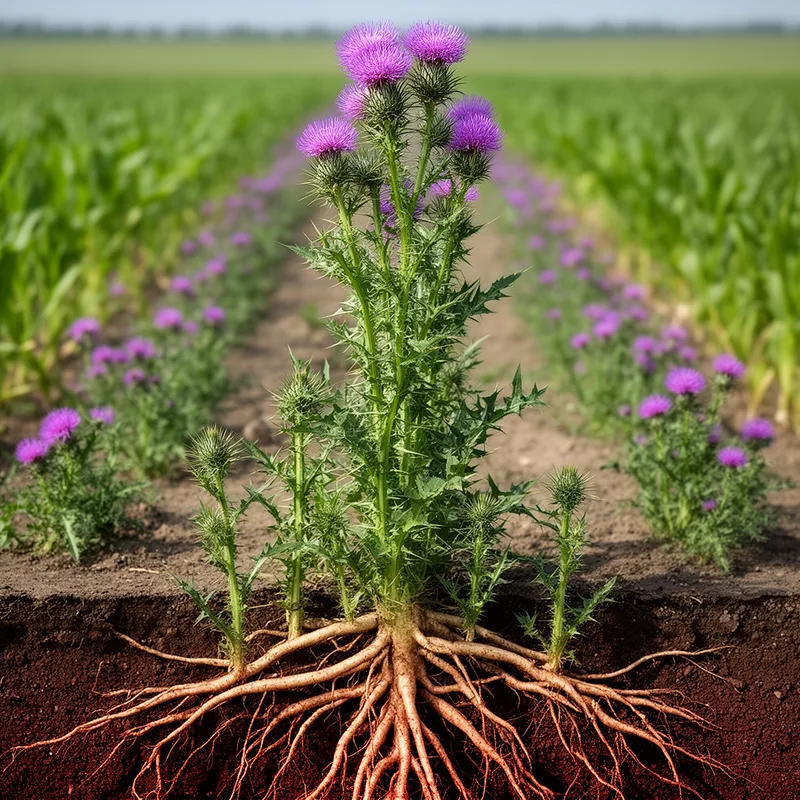
Cirsium arvense
- noun
- Specialized
- Cirsium arvense is commonly known as Canada thistle, and it often invades pastures and farms, reducing crop yields.
Examples
-
Farmers often struggle to eliminate Cirsium arvense from their land due to its persistent roots.
-
Cirsium arvense can quickly take over agricultural fields, making it difficult for crops to thrive.
-
Authorities have launched programs to control the spread of Cirsium arvense in rural regions.
-
The Cirsium arvense plant is often found in disturbed areas.
-
Farmers are concerned about the spread of Cirsium arvense in their fields.
-
The proliferation of Cirsium arvense in North America has led to significant concerns among agricultural communities.
-
To combat the threats posed by Cirsium arvense, many farmers implement integrated weed management strategies.
Synonyms

A spiny plant with purple flowers that spreads quickly and harms crops and gardens

A common weed with purple flowers and roots that spread underground
Surface Forms
Morphology
Cirsium + arvense
This is a Latin scientific binomial (genus + species) rather than a compositional English phrase; the species epithet 'arvense' is not an English word and the genus name 'Cirsium' is a technical botanical term. Average B1 learners would not be able to derive the specific meaning ('a particular thistle species / invasive weed') from these constituents because taxonomic names are conventional and non-compositional in everyday English.
Etymology
Cirsium arvense comes from old words that describe a thistle in fields. Cirsium is an old word for a 'thistle' and arvense means 'of the fields', so the name gives a picture of a spreading plant that takes over farmland and is now seen as a weed.

