
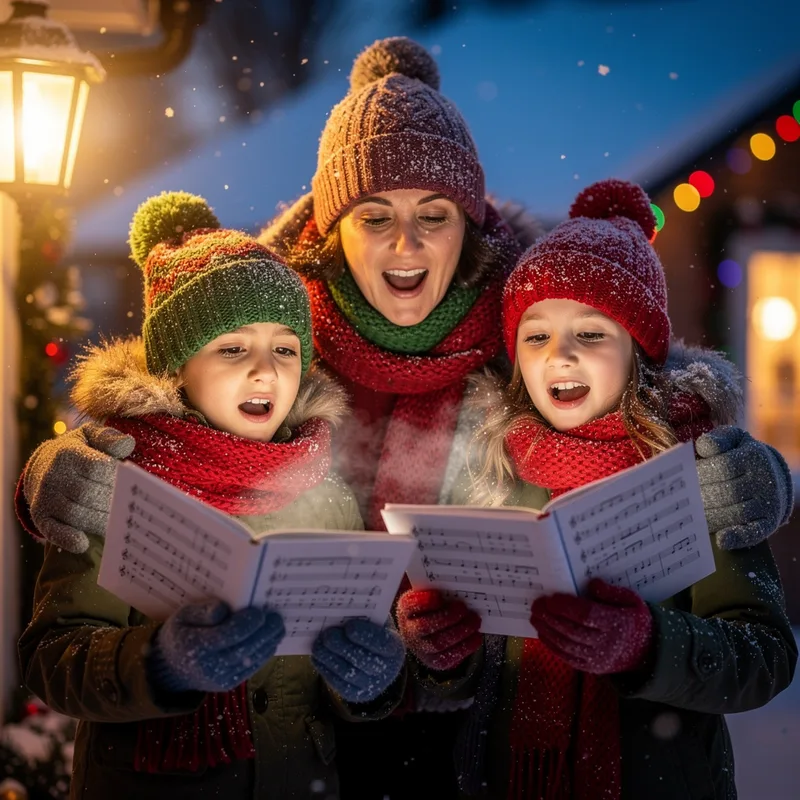
Christmas carol
 19
1.3
19
1.3

- noun
- /ˈkrɪs·məs ˈkɛr·əl/
- During the festive season, we gathered around the fireplace to sing a joyful Christmas carol celebrating the birth of Jesus.
- singing Christmas carols
Loading YouTube…
Watch on YouTubeAnd I love Christmas carols even though I don't believe in God.
- And I love Christmas carols even though I don't believe in God.
- That sounds like the saddest Christmas Carol ever.
- Like, like I just sold flowers and I, I sold lemonade and, and I'm Jewish and I sang Christmas carols like fucking, it was my last song.
Examples
-
None of it makes me feel like singing Christmas carols.
Fiction book (1998) -
Overwhelmed, I wiped away the tears as I listened to the Christmas carols.
Academic text (1996) -
"And she taught us the Christmas carol we will sing for you after dinner."
Fiction book (1994) -
Do you like Christmas carols, Peter?
-
On the steps of the old church, a choir sings Christmas carols.
Fiction book (2000) -
And I love Christmas carols even though I don't believe in God.
-
Then you would all gather around the old pump organ and sing Christmas carols, just as we did tonight.
Fiction book (1990) -
My girls had a great time singing Christmas carols and waving to Santa.
Blog text (21) -
In the next room, Tom's at the piano and the kids are singing Christmas carols.
Fiction book (1993) -
Samuel then cradles his younger daughter, Alma-Rose, in his lap and starts singing Christmas carols to her softly.
Academic text (1996)
Synonyms
 601
2.3
601
2.3
A happy song that people sing at Christmas
A Christmas song that people sing during the holidays
Surface Forms
Morphology
The MWE meaning is directly compositional: 'Christmas' specifies the occasion and 'carol' already means a joyful religious song sung at Christmas, so the combined meaning is immediately derivable from the parts. This noun+noun collocation is conventional and cross-linguistically common, so a B1 learner who knows both constituents will understand it.
Etymology
The name Christmas carol comes from the older word carol, which long ago meant a circle dance where people sang together in a ring. Because these lively songs were often sung at Christmas festivals, Christmas carol came to mean a 'joyful religious song' for the holiday.