

Chlamydomonas


 1
9.9
1
9.9
- noun
- /kləˌmɪdəˈmoʊnəs/
- Specialized
- The genus Chlamydomonas is often found in freshwater ponds and is known for its ability to reproduce rapidly.
Examples
-
Bacteria attached to the surface of Chlamydomonas appear as threadlike structures on the upper portion of the cell; flagella are evident on the right apex of the cell. HNAN, heterotrophic nanoflagellates.
Academic text (1999) -
Although we apply our protocol to Chlamydomonas reinhardtii as a model organism, it can easily be adapted to any other organism that can be grown in cell culture and is able to use ammonium or nitrate as a nitrogen source.
Blog text (15) -
Similar results were recently reported when RNA-seq was used to evaluate gene expression in Chlamydomonas reinhardtii, in which only modest changes in gene expression of fatty acid metabolism genes were reported.
Blog text (18) -
The green alga Chlamydomonas thrives in damp soil and contributes significantly to the aquatic ecosystem.
-
Scientists study Chlamydomonas for its unique characteristics, including its two flagella that aid in movement.
Synonyms
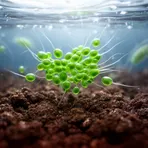
A group of small, single-celled green algae with two tail-like flagella found in fresh water and damp soil
Compounds
- Specialized
A group of small, single-celled green algae with two tail-like flagella found in fresh water and damp soil
Surface Forms
Etymology
Chlamydomonas comes from Greek parts chlamydo- meaning 'cloak' and -monas meaning 'single'. So think of Chlamydomonas as a 'single' cell with a tiny 'cloak' that swims with two small tails, which helps you remember it is a one-celled green alga.